 ADevGuide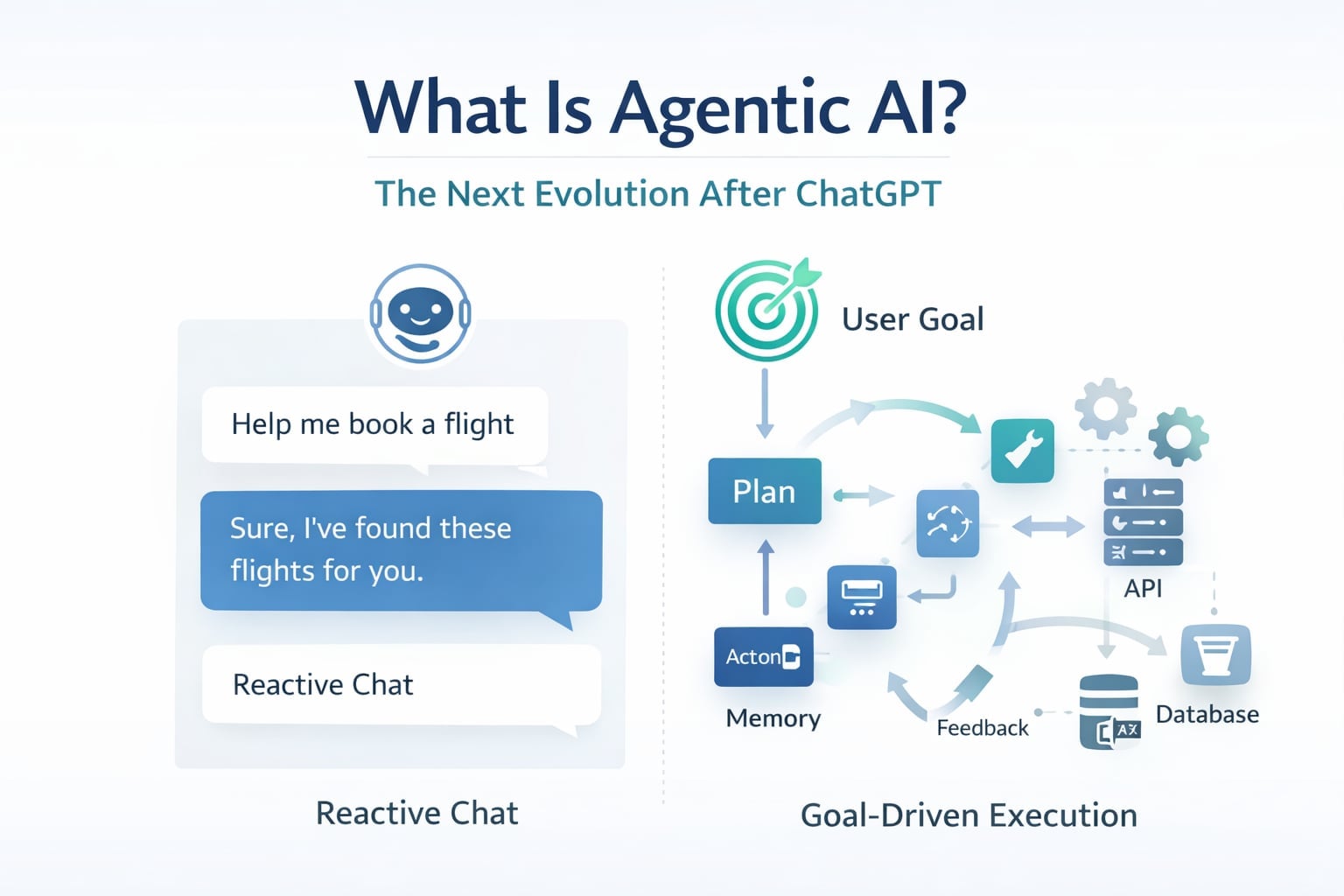
Agentic AI is the term people use when AI moves from answering prompts to pursuing goals. A chatbot like ChatGPT mainly responds to what you ask in the current turn. An agentic system can plan, choose tools, take actions, evaluate progress, and continue until it reaches a defined outcome.
That is why many teams describe agentic AI as the next practical step after ChatGPT. The shift is not from “old AI” to “new AI.” The shift is from prompt-response assistants to goal-driven systems.
If you already follow the AI Engineering hub, the LLM agents hub, or the broader AI Agents category, this post fits directly into that same progression. For deeper supporting context, read What is MCP (Model Context Protocol)? Understanding the Differences, Retrieval-Augmented Generation (RAG) for Beginners: A Complete Guide, and What Are AI Agent Skills? How Claude Skills Work.
Table of Contents
Open Table of Contents
- What Is Agentic AI?
- Why It Feels Like the Step After ChatGPT
- Agentic AI vs ChatGPT vs AI Assistants
- How Agentic AI Works
- Core Components of an Agentic System
- Single-Agent vs Multi-Agent Systems
- Real-World Examples and Use Cases
- Risks and Limitations
- How Developers Should Think About Building Agentic AI
- FAQs
- 1. What is the simplest definition of agentic AI?
- 2. How is agentic AI different from ChatGPT?
- 3. Why is agentic AI considered the next evolution after chatbots?
- 4. What are the core components of an agentic system?
- 5. When should a company avoid full autonomy?
- 6. Is multi-agent architecture always better than a single agent?
- Conclusion
- References
- YouTube Videos
What Is Agentic AI?
Agentic AI is AI designed to achieve a goal with limited supervision. Instead of stopping at a single answer, it can break work into steps, decide what to do next, use tools or data sources, and adapt when conditions change.
The core idea is agency:
- The system has a goal.
- It plans how to reach that goal.
- It takes actions.
- It checks the results.
- It continues or adjusts until it completes the job.
That is the main difference from classic chat interfaces. A normal chatbot is mostly reactive. Agentic AI is more goal-directed.
This does not mean agentic AI is magical or fully independent. In production, people still define the scope, permissions, tools, and safety rules. But within those boundaries, the system can operate with much more initiative than a prompt-only assistant.
Why It Feels Like the Step After ChatGPT
ChatGPT made the prompt-response model mainstream:
- Ask a question.
- Get an answer.
- Ask a follow-up.
- Repeat.
That interaction model is powerful, but it is still centered on the user driving every step manually.
Agentic AI changes that operating model. Instead of saying:
- “Summarize these support tickets”
You can say:
- “Review today’s support tickets, group them by severity, draft replies for the urgent ones, and escalate anything that suggests account compromise.”
Now the system may need to:
- Read multiple tickets.
- Classify them.
- Retrieve account context.
- Decide which tool to call.
- Draft outputs.
- Hand high-risk cases to a human.
That is why the phrase “after ChatGPT” resonates. For many users, ChatGPT introduced conversational AI. Agentic AI introduces workflow AI.
A useful mental model is:
- ChatGPT-style assistant: “I answer.”
- Agentic AI system: “I work toward an outcome.”
Agentic AI vs ChatGPT vs AI Assistants
These terms get mixed together, so it helps to separate them.
| Concept | Primary behavior | Example |
|---|---|---|
| Chatbot | Responds to prompts in conversation | ”Explain JWTs” |
| AI assistant | Helps with user-requested tasks, often with some tools | ”Draft this email and summarize my notes” |
| Agentic AI | Pursues goals through planning, action, and feedback loops | ”Resolve simple refund requests end to end” |
Important nuance:
- ChatGPT can be part of an agentic system.
- An assistant can show some agentic behavior.
- Agentic AI is not one model. It is usually a system design pattern built around models, tools, memory, policies, and orchestration.
That is also why posts like What Is Sub-Agent in Claude Code? Complete Developer Guide matter. Modern agent systems are often not just one assistant with one prompt. They are coordinated workflows with specialized roles.
How Agentic AI Works
At a high level, an agentic system runs in a loop:
- Receive a goal.
- Understand the current state.
- Create or update a plan.
- Choose the next action.
- Use a tool, API, database, browser, or model call.
- Evaluate the result.
- Stop, escalate, or continue.
flowchart TD
  A[User Goal] --> B[Agent or Planner]
  B --> C[Read Context and Memory]
  C --> D[Create or Update Plan]
  D --> E[Choose Next Action]
  E --> F[Use Tool or Model]
  F --> G[Evaluate Result]
  G --> H{Goal Completed?}
  H -->|No| D
  H -->|Needs human review| I[Escalate to Human]
  H -->|Yes| J[Return Final Outcome]

  classDef agent fill:#e8f5e9,stroke:#2e7d32,stroke-width:2px,color:#000000;
  class A,B,C,D,E,F,G,H,I,J agent;
This loop is what makes the system feel agentic. It does not just produce text once. It keeps reasoning about what to do next.
In practice, the “evaluate result” step is critical. Without it, the system is just blindly chaining actions. Good agentic systems check whether:
- the tool call succeeded
- the output is relevant
- another step is needed
- a human should take over
Core Components of an Agentic System
Most serious agentic systems include these building blocks.
1. A model for reasoning
Usually an LLM handles planning, decision support, or synthesis.
2. Tools
The agent needs ways to act:
- call APIs
- search the web
- read files
- write to systems
- query databases
3. Memory and context
The system often needs short-term working memory, conversation state, or retrieved knowledge. This connects directly to RAG, which helps agents ground decisions in current information.
4. Orchestration
Something has to coordinate the loop, route subtasks, and enforce execution order. This is where frameworks, planners, and controller logic matter.
5. Guardrails
Production systems need permission boundaries, validation rules, approval steps, and rollback strategies.
6. Observability
If an agent takes ten steps and fails on step eight, the team must know why. Logs, traces, token usage, tool-call history, and policy events are not optional in real deployments.
Single-Agent vs Multi-Agent Systems
Not every agentic system needs many agents.
Single-agent setup
One agent handles the goal, uses tools, and loops until done.
Good fit:
- personal workflow automation
- simple internal copilots
- report generation
- triage bots with narrow scope
Multi-agent setup
Multiple specialized agents collaborate under some orchestration layer.
Example:
- A planner agent breaks down the task.
- A research agent gathers evidence.
- A tool agent executes API operations.
- A reviewer agent checks quality or policy compliance.
Good fit:
- complex enterprise workflows
- broad cross-system automation
- situations where separation of roles improves control
But multi-agent systems are harder to debug, govern, and evaluate. More agents do not automatically mean a better system. Often, one well-designed agent with good tools is the stronger engineering choice.
Real-World Examples and Use Cases
This is where agentic AI becomes concrete.
1. Customer support operations
An agent can:
- read the incoming ticket
- retrieve order or subscription context
- classify urgency
- draft a response
- trigger a refund workflow when policy allows
- escalate fraud or legal issues to a human
This moves beyond chat. The system is not just explaining policy. It is operating inside the workflow.
2. Security operations
Google Cloud’s agentic SOC framing is a good example of how this shows up in practice. Instead of one model summarizing alerts, multiple agents can triage signals, enrich findings, recommend actions, and help analysts move faster through repetitive steps.
3. Data and analytics workflows
Google Cloud’s architecture examples also show agentic systems running multi-step data tasks, such as retrieving datasets, choosing analysis steps, generating queries, and producing final outputs for the user.
4. Enterprise copilots that actually act
This is where the ChatGPT comparison matters most. A traditional assistant might suggest what to do next. An agentic system can often do the next step itself, if the permissions and controls are in place.
That is also why protocol-level foundations like MCP matter: the more agents need external tools, the more important structured access and governance become.
Risks and Limitations
The hype around agentic AI is high, but the engineering risks are real.
1. Wrong actions are more expensive than wrong answers
If a chatbot gives a weak answer, a user can ignore it. If an agent takes the wrong action in a live system, it can create cost, security, or trust problems.
2. Tool misuse
The moment agents can browse, write, purchase, update, or execute, permission design becomes a core security problem.
3. Hidden failure chains
Agentic systems often have more moving parts:
- model decision
- tool call
- retrieved context
- memory state
- orchestration logic
That means failures can be harder to trace than a normal chat response.
4. Over-automation
Teams sometimes try to automate judgment-heavy decisions too early. Human approval is still the right choice for finance, legal, security, or customer-impacting actions.
5. Cost and latency
More reasoning loops, more tool calls, and more evaluations can increase both runtime and spend. Agentic AI is often more capable than prompt-only chat, but it is also operationally heavier.
How Developers Should Think About Building Agentic AI
The strongest approach is not “add more autonomy everywhere.” The strongest approach is controlled autonomy.
Practical design rules:
- Start with one narrow workflow and a clear success metric.
- Give the agent only the tools it actually needs.
- Add validation after every important action.
- Use human approval for high-impact steps.
- Log every decision and tool call.
- Prefer boring reliability over theatrical autonomy.
A useful sequence for teams is:
- Build a strong assistant first.
- Add tool use.
- Add limited planning and retries.
- Add evaluation and approval loops.
- Expand scope only after you trust the system.
That staged approach is usually better than jumping directly into a complex multi-agent architecture.
FAQs
1. What is the simplest definition of agentic AI?
Agentic AI is AI that works toward a goal with limited supervision. Instead of only answering prompts, it can plan steps, use tools, act on systems, and adapt based on results.
2. How is agentic AI different from ChatGPT?
ChatGPT is commonly used as a conversational assistant that responds to prompts turn by turn. Agentic AI is built to pursue an outcome across multiple steps. It may still use an LLM like ChatGPT, but the overall system adds orchestration, tools, memory, and execution loops.
3. Why is agentic AI considered the next evolution after chatbots?
Because it changes AI from a response interface into a workflow interface. Instead of helping users think through the next step, the system can often perform the next step itself within defined safety boundaries.
4. What are the core components of an agentic system?
Most agentic systems need a reasoning model, tools, context or memory, orchestration logic, guardrails, and observability. Missing any one of those usually creates reliability or control problems.
5. When should a company avoid full autonomy?
Companies should avoid full autonomy when the action is expensive, legally sensitive, security-critical, or difficult to reverse. In those cases, human approval or human-in-the-loop review is usually the correct design.
6. Is multi-agent architecture always better than a single agent?
No. Multi-agent systems can improve specialization and coordination for complex workflows, but they also increase orchestration, debugging, and governance complexity. A single well-scoped agent is often the more robust first version.
Conclusion
Agentic AI is best understood as the move from conversational AI to outcome-oriented AI. ChatGPT popularized the idea that AI can talk. Agentic AI pushes that idea further by asking whether AI can plan, act, and complete useful work inside real systems.
That is why the phrase “the next evolution after ChatGPT” makes sense, as long as you use it carefully. Agentic AI is not a replacement for all assistants, and it is not one magical model. It is a more operational pattern for building AI systems that can pursue goals under guardrails.
If you keep the distinction clear, the concept becomes much less hype-driven:
- Chatbots respond.
- Assistants help.
- Agentic systems act.
That is the progression most developers and product teams are now trying to understand.
References
- IBM: What is agentic AI?
- NVIDIA: What Is Agentic AI?
- Google Cloud: What is agentic AI? Definition and differentiators
- Google Cloud Architecture Center: Agentic AI architecture guides
YouTube Videos
- “The Power of AI Agents and Agentic AI Explained” - IBM Technology
https://www.youtube.com/watch?v=2j26a5dmCnI - “Transform Your Business With Agentic AI” - NVIDIA
https://www.youtube.com/watch?v=afWBnxWQDKk