 ADevGuide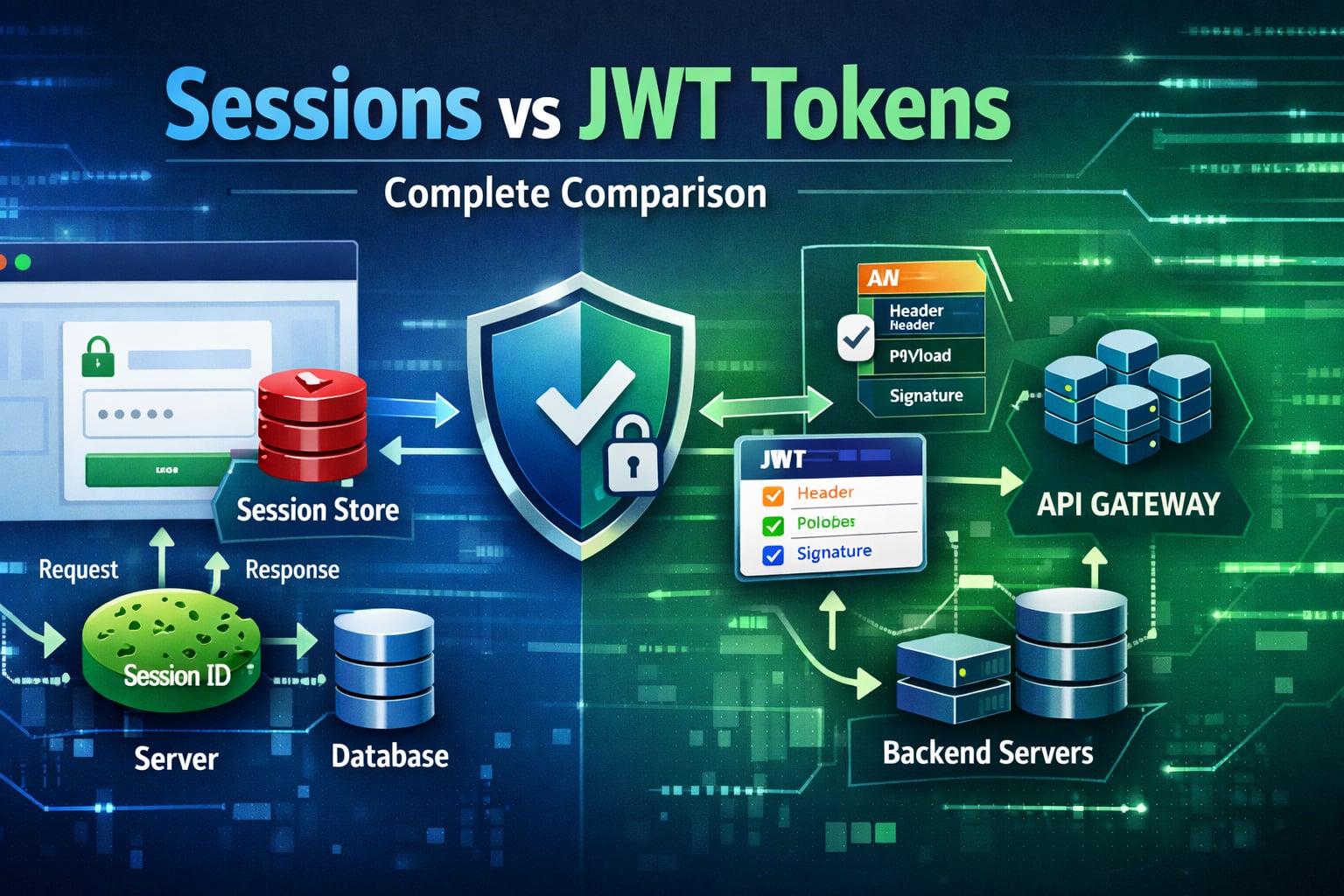
JWT vs session authentication is a comparison every backend developer runs into sooner or later. Both approaches solve the same product problem, but they differ in where auth state lives, how requests are validated, and how much operational complexity you accept in exchange for portability.
If you are still building the broader request pipeline mental model, start with How APIs Work: A Simple Guide for Beginners and Authentication vs Authorization: What’s the Difference? first, then come back here.
Table of Contents
Open Table of Contents
- Quick Definition
- Why This Comparison Confuses Beginners
- How Session-Based Authentication Works
- How JWT Authentication Works
- JWT vs Session Authentication: Side-by-Side Comparison
- Security Trade-Offs That Matter
- Scalability, Revocation, and Operational Complexity
- When Sessions Are the Better Choice
- When JWTs Are the Better Choice
- Real-World Example: SaaS Dashboard with API and Mobile App
- Common Mistakes Developers Make
- Interview Questions
- 1. Why are cookies and JWTs not direct alternatives?
- 2. When would you choose sessions over JWT for a web application?
- 3. Why is JWT revocation harder than session revocation?
- 4. Does using JWT remove the need for database or cache lookups?
- 5. Can a secure system use both sessions and JWTs at the same time?
- 6. What is the strongest simple answer to “Which is better: sessions or JWT?”
- Conclusion
- References
- YouTube Videos
Quick Definition
- Session-based authentication stores the important auth state on the server. The client usually only stores a session ID, most often inside a cookie.
- JWT authentication stores signed claims inside a token that the client sends back on later requests. The server verifies the token instead of looking up most auth state by session ID.
Practical summary:
- Sessions are usually stateful on the server.
- JWTs are usually self-contained on the client side.
- Cookies are not the opposite of JWTs. A cookie can carry a session ID or a JWT.
That last point causes most beginner confusion.
Why This Comparison Confuses Beginners
People often compare:
- cookies vs JWT
- sessions vs localStorage
- session auth vs token auth
Those are not the same categories.
Here is the clean model:
| Concept | What it is | Example |
|---|---|---|
| Cookie | Browser transport/storage mechanism | Set-Cookie: sid=abc123; HttpOnly; Secure |
| Session | Server-side authentication model | Session data stored in Redis or database |
| JWT | Token format for signed claims | header.payload.signature |
That means all of these are possible:
- Session ID stored in an HttpOnly cookie.
- JWT stored in an HttpOnly cookie.
- JWT sent in an
Authorization: Bearerheader.
So the real question is not “cookies or JWT?” The real question is:
- Do I want the server to own auth state directly?
- Or do I want the client to present signed identity claims on each request?
How Session-Based Authentication Works
With session authentication, the server creates and owns the session record.
Typical flow:
- User logs in with credentials.
- Server verifies credentials.
- Server creates a session record such as
{ sessionId, userId, roles, expiresAt }. - Server sends the session ID back to the browser in a cookie.
- Browser automatically sends the cookie on later requests.
- Server looks up the session by ID and restores user context.
flowchart TD
  A[User Login Request] --> B[Auth Service]
  B --> C{Credentials Valid?}
  C -->|No| D[401 Unauthorized]
  C -->|Yes| E[Create Server Session]
  E --> F[(Session Store)]
  F --> G[Set-Cookie sessionId]
  G --> H[Browser]
  H --> I[Later Request with Cookie]
  I --> J[Lookup Session by ID]
  J --> F
  J --> K[Run Protected Action]

  classDef auth fill:#e8f5e9,stroke:#2e7d32,stroke-width:2px,color:#000000;
  class A,B,C,D,E,F,G,H,I,J,K auth;
Example response after login:
HTTP/1.1 200 OK
Set-Cookie: sid=s_8f13f2; HttpOnly; Secure; SameSite=Lax; Path=/
Content-Type: application/json

{
  "user": {
    "id": "u_42",
    "name": "Priya"
  }
}
Important operational benefits:
- Logout is simple: delete the server session.
- Forced revocation is simple: invalidate the session record.
- Permission changes take effect quickly because the server stays in control.
This is why session auth remains strong for browser-first products, admin portals, and internal dashboards.
How JWT Authentication Works
With JWT authentication, the server issues a signed token that contains claims about the caller.
Typical flow:
- User logs in.
- Auth service verifies credentials.
- Auth service issues a signed JWT with claims such as
sub,iss,aud,exp, and maybe scopes or roles. - Client sends that JWT on later requests.
- Backend verifies signature and claims before serving the request.
flowchart TD
  A[User Login Request] --> B[Auth Service]
  B --> C{Credentials Valid?}
  C -->|No| D[401 Unauthorized]
  C -->|Yes| E[Issue Signed JWT]
  E --> F[Client Stores Token]
  F --> G[Later Request with Bearer Token]
  G --> H[API or Gateway]
  H --> I{Signature and Claims Valid?}
  I -->|No| J[401 Unauthorized]
  I -->|Yes| K[Run Protected Action]

  classDef jwt fill:#e8f0fe,stroke:#1565c0,stroke-width:2px,color:#000000;
  class A,B,C,D,E,F,G,H,I,J,K jwt;
Example request:
GET /api/v1/orders HTTP/1.1
Authorization: Bearer eyJhbGciOiJSUzI1NiIsInR5cCI6IkpXVCJ9...
Two important clarifications:
- A JWT is usually signed, not encrypted. Do not put secrets or sensitive internal data in it unless you are deliberately using encryption.
- Real JWT systems usually still have some server-side state for refresh tokens, key rotation, logout events, or compromised-account handling.
That is why “JWT means no state anywhere” is usually an oversimplification.
JWT vs Session Authentication: Side-by-Side Comparison
| Dimension | Sessions | JWT |
|---|---|---|
| State location | Server-side | Mostly in token claims |
| Client payload | Small session ID | Larger signed token |
| Validation path | Session lookup | Signature + claims validation |
| Logout/revocation | Easy | Harder unless token is short-lived or tracked |
| Browser support | Very natural with cookies | Works, but storage choice matters |
| Mobile/API fit | Fine, but less portable | Very common |
| Multi-service propagation | Needs shared session strategy | Easier to forward identity claims |
| Permission changes | Easy to reflect immediately | Can lag until token refresh |
| Operational cost | Session store, expiration, replication | Key management, token expiry, refresh flow, validation rules |
My rule of thumb:
- Sessions optimize for control and simplicity.
- JWTs optimize for portability and distributed verification.
Neither is universally better.
Security Trade-Offs That Matter
The security discussion is where teams make the most expensive mistakes.
Sessions: security strengths and risks
Strengths:
- Session data stays server-side, so the client does not hold the full identity context.
- Revocation is immediate once the session is deleted.
- Browsers handle cookie sending automatically, which keeps frontend code simpler.
Risks:
- If session cookies are not
HttpOnly, XSS can steal them. - If cookie settings are weak, CSRF becomes a real risk.
- If session IDs are not rotated on login or privilege change, session fixation can happen.
Good practice:
- Use
HttpOnly,Secure, and a sensibleSameSitesetting. - Rotate the session ID after login.
- Expire idle sessions.
- Invalidate sessions on logout and major privilege changes.
JWTs: security strengths and risks
Strengths:
- APIs and multiple services can verify a signed token without hitting a central session store on every request.
- Short-lived access tokens reduce replay windows when paired with solid refresh-token design.
- Standard claims such as
iss,aud,sub, andexpcreate a predictable validation model.
Risks:
- A JWT that leaks remains usable until expiry unless you add revocation controls.
- Storing JWTs in
localStorageor other script-accessible places increases XSS blast radius. - Teams often trust token claims too much and stop checking current server-side policy.
Good practice:
- Keep access tokens short-lived.
- Validate signature, issuer, audience, expiry, and any token type rules.
- Use refresh tokens carefully and rotate them.
- Treat JWT payload as visible data, not a secret vault.
If transport security is still fuzzy, review HTTP vs HTTPS: What’s the Difference?. Auth design gets weaker fast when tokens or cookies move over insecure channels.
Scalability, Revocation, and Operational Complexity
This is the part that usually drives the architecture decision.
Why sessions can still scale
Many developers hear “sessions do not scale” and stop there. That is outdated.
Modern session architectures usually store sessions in a shared system such as Redis, not only in one app server’s memory. That means:
- Multiple app servers can read the same session data.
- Rolling deploys do not wipe all sessions.
- Revocation still stays simple.
Yes, that adds infrastructure. But for many products, that infrastructure is easier than debugging JWT misuse in production.
Why JWTs are not magically stateless
JWTs reduce lookup pressure for simple auth verification, but real systems still need state for:
- Refresh token tracking.
- User suspension or forced logout.
- Key rotation and token invalidation windows.
- Current permission or tenant checks.
That means JWTs often move state around rather than removing it entirely.
Revocation is the real dividing line
If you must revoke access immediately, sessions are usually cleaner.
Examples:
- Employee loses admin access right now.
- Suspicious account must be logged out everywhere.
- Paid subscription ended and protected features must stop immediately.
A JWT system can handle those cases, but it usually needs one or more of these:
- Very short access-token expiry.
- Refresh-token revocation.
- Token versioning or deny lists.
- Extra authorization lookups anyway.
That is why JWT is not automatically the simpler option.
When Sessions Are the Better Choice
I would choose sessions first when most of these are true:
- The main client is a browser app on your own domain.
- You want login, logout, and forced revocation to stay simple.
- Your backend is a monolith or a small number of services.
- Your team prefers server-controlled security over token portability.
Typical examples:
- internal admin panels
- SaaS dashboards
- server-rendered apps
- back-office tools
For these systems, session auth is often the boring, correct choice. Boring is good in authentication.
When JWTs Are the Better Choice
I would choose JWT access tokens when most of these are true:
- You have mobile apps, third-party consumers, or many resource servers.
- Multiple services need to verify identity without central session lookup on every request.
- Short-lived tokens and refresh flows are acceptable complexity.
- Your team is prepared to manage signing keys, expiry, token rotation, and claim validation rules.
Typical examples:
- mobile APIs
- public developer platforms
- federated identity systems
- service-to-service identity propagation
Even here, I would still keep the design disciplined:
- Short-lived access token.
- Refresh token with server-side control.
- Minimal claims.
- Re-check sensitive permissions server-side.
Real-World Example: SaaS Dashboard with API and Mobile App
Imagine a B2B SaaS product with:
- a browser-based admin dashboard
- a public REST API for customer integrations
- a mobile app for field staff
Using one auth model everywhere sounds neat, but it is often the wrong optimization.
Browser dashboard
For the dashboard, session-based auth is usually the simpler choice:
- User logs in on your web app.
- Server sets an HttpOnly session cookie.
- Browser sends it automatically.
- Server can revoke access immediately if the user’s role changes.
This works especially well when the app and API stay on the same trusted site boundary.
Public API and mobile app
For mobile and third-party API consumers, JWT access tokens make more sense:
- Client authenticates with the auth service.
- Auth service issues a short-lived access token.
- Client sends the access token to protected APIs.
- Refresh token lifecycle stays under tighter server-side control.
What the hybrid design buys you
You avoid forcing browser ergonomics and public API ergonomics into one model.
That hybrid is common in production because it respects the clients:
- browser session auth for web UX
- JWT access tokens for distributed API consumption
If you are mapping this to the bigger HTTP contract, What Is REST API? Beginner’s Guide with Examples and HTTP Status Codes Explained (200, 404, 500 and More) are the best follow-up reads.
Common Mistakes Developers Make
1. Comparing cookies directly to JWTs
A cookie is a browser mechanism. A JWT is a token format. They are not equivalent concepts.
2. Assuming JWT means more secure by default
JWT is not a security upgrade by itself. A badly validated or long-lived JWT setup can be weaker than a well-designed session system.
3. Storing long-lived access tokens in localStorage
If XSS happens, script-accessible tokens are easier to steal. Storage choice matters as much as token choice.
4. Putting too much authorization logic inside token claims
A token can carry useful claims, but highly sensitive authorization still needs current server-side checks. Otherwise role changes, tenant changes, or account locks may take too long to apply.
5. Believing sessions cannot scale
They can. Shared session stores are routine now. The real question is whether that operational model matches your system better than token verification and refresh-token lifecycle management.
6. Forgetting token and session lifecycle events
Authentication design is not just login success. You need logout, expiry, rotation, revocation, ban handling, and incident response.
For a broader path across these topics, browse the Web Fundamentals hub and the API tag archive. They connect this post to the rest of the API and backend basics series.
Interview Questions
1. Why are cookies and JWTs not direct alternatives?
Because they solve different layers of the problem. Cookies are one way for browsers to store and send data back automatically. JWTs are a structured token format that carries signed claims.
You can store a session ID in a cookie, and you can also store a JWT in a cookie. So the better comparison is server-side sessions versus token-based authentication, not cookies versus JWT.
2. When would you choose sessions over JWT for a web application?
I would choose sessions when the main client is a browser app on the same trusted domain and I want strong server-side control over logout, revocation, and permission changes.
The big advantage is operational clarity. If a user must lose access immediately, deleting the session is direct and predictable. That matters a lot for admin tools and internal systems.
3. Why is JWT revocation harder than session revocation?
Because a valid JWT can often be verified locally until it expires. If you do not maintain a deny list, token version check, or short expiry plus refresh-token control, the server may have no direct way to stop a leaked token immediately.
A session system does not have that problem in the same way. Delete the session record, and the next request fails.
4. Does using JWT remove the need for database or cache lookups?
Not usually. JWT can remove some identity lookups, but most real systems still need to check current user state, subscription status, tenant membership, feature flags, or fine-grained permissions.
So JWT often reduces one class of lookup while leaving several business-critical lookups in place.
5. Can a secure system use both sessions and JWTs at the same time?
Yes, and many good systems do. A product might use session cookies for the browser dashboard and short-lived JWT access tokens for mobile apps or partner APIs.
That is not inconsistency. It is matching the auth model to the client and threat model.
6. What is the strongest simple answer to “Which is better: sessions or JWT?”
Neither is better in the abstract. Sessions are usually better when you want simpler revocation and browser-first ergonomics. JWTs are usually better when you need portable signed identity across distributed clients and services.
The strongest interview answer explains the trade-off instead of declaring one winner.
Conclusion
Sessions and JWT tokens are both useful, but they optimize for different priorities.
If you want server-controlled authentication, immediate revocation, and simpler browser flows, choose sessions. If you want portable signed identity for mobile clients, distributed APIs, or multiple resource servers, JWT access tokens can be the better fit.
The mistake is not choosing one or the other. The mistake is choosing JWT because it sounds modern, or choosing sessions because they feel old-school, without matching the decision to client type, revocation needs, and operational reality.
References
- RFC 6265 - HTTP State Management Mechanism
https://www.rfc-editor.org/rfc/rfc6265 - RFC 7519 - JSON Web Token (JWT)
https://www.rfc-editor.org/rfc/rfc7519 - RFC 8725 - JSON Web Token Best Current Practices
https://www.rfc-editor.org/rfc/rfc8725 - MDN: Set-Cookie Header
https://developer.mozilla.org/en-US/docs/Web/HTTP/Headers/Set-Cookie
YouTube Videos
- “Session Vs JWT: The Differences You May Not Know!” - ByteByteGo
https://www.youtube.com/watch?v=fyTxwIa-1U0 - “Cookies, Sessions, JSON Web Tokens (JWT) and More” - LearnWebCode
https://www.youtube.com/watch?v=uXDnS5PcjCA