 ADevGuide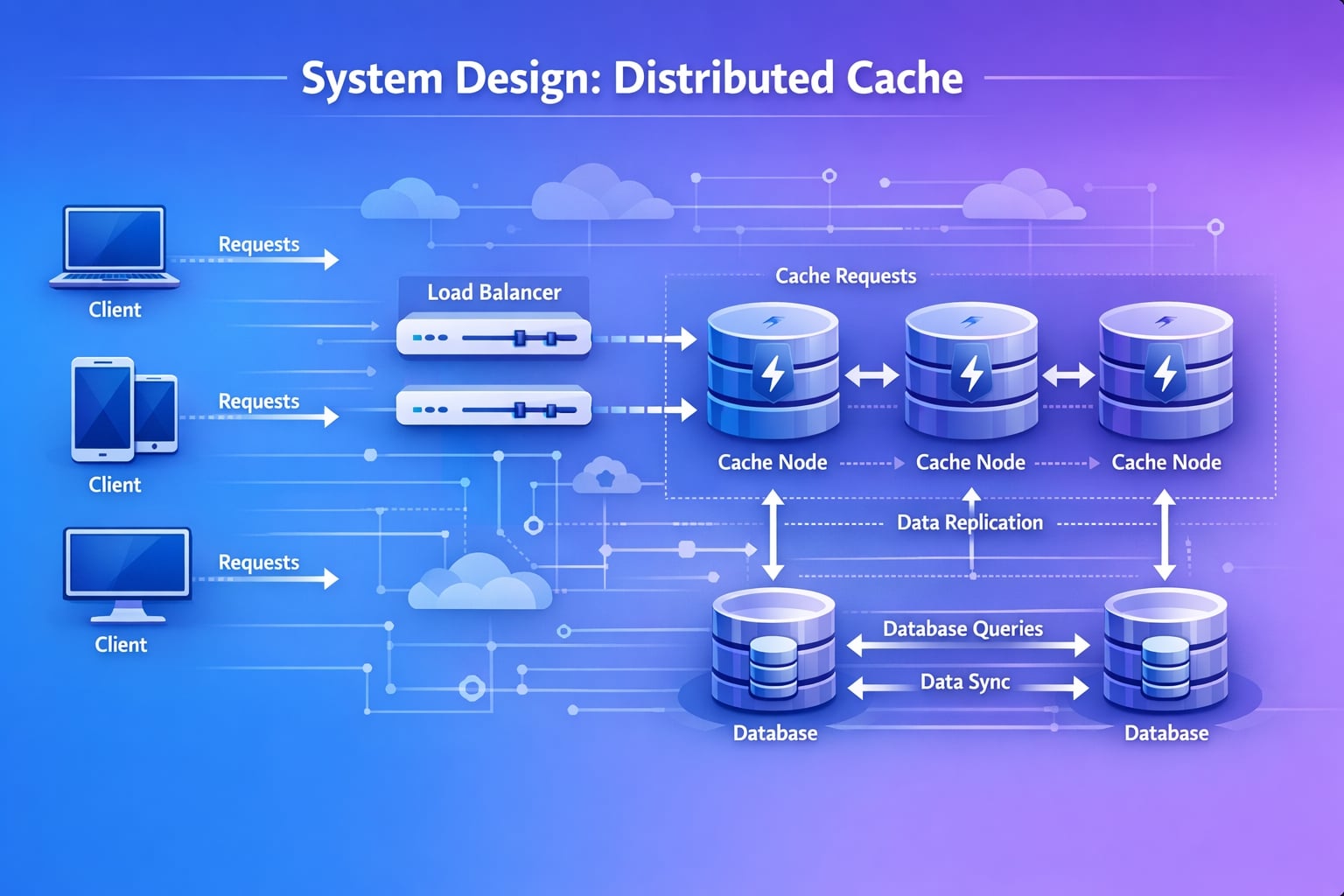
A distributed cache is the backbone of almost every high-scale system. Whether it’s storing session data, reducing database load, or serving real-time leaderboards, systems like Redis and Memcached are ubiquitous. In this guide, we’ll design a scalable, fault-tolerant distributed cache from scratch. If you are preparing for interviews, keep our system design interview cheatsheet handy, review how caching fits into why caching improves performance, and browse the full System Design hub for more patterns.
Table of Contents
Open Table of Contents
- Interview Framework: How to Approach This Problem
- Step 1: Clarifying Requirements
- Step 2: Core Assumptions and Constraints
- Step 3: High-Level Architecture
- Step 4: The Hardest Problem - Data Partitioning
- Step 5: Eviction Policies (LRU, LFU, FIFO)
- Step 6: Data Consistency Models
- Step 7: Scaling the System
- Step 8: High Availability and Replication
- Step 9: Handling Edge Cases
- Step 10: Performance Optimizations
- Real-World Implementations
- Common Interview Follow-Up Questions
- Q: Redis is single-threaded. How does it scale to millions of requests per second?
- Q: How do you prevent cache stampede when a hot key expires?
- Q: How would you keep cache and database consistent?
- Q: How do you implement a safe distributed lock?
- Q: How do you handle hot keys and uneven shard traffic?
- Conclusion
- References
- YouTube Videos
Interview Framework: How to Approach This Problem
In a system design interview, when asked to design a distributed cache (like Redis or Memcached), here’s the structured approach you should follow:
- Clarify requirements (5 minutes) - Determine if it’s a simple key-value store or requires complex data types.
- State assumptions (2 minutes) - Define read/write ratios and latency targets.
- High-level design (10 minutes) - Sketch the client, load balancer, and cache nodes.
- Deep dive (20 minutes) - Focus on Sharding (Consistent Hashing) and Eviction Policies.
- Scale and optimize (10 minutes) - Discuss replication, gossip protocols, and TCP optimizations.
- Edge cases (3 minutes) - Thundering herd problem, hot keys.
Key mindset: This is a data-intensive design. Focus heavily on how data is partitioned (sharding) and how memory is managed (eviction).
Step 1: Clarifying Requirements
Questions to Ask the Interviewer
Q: What is the primary access pattern?
- A: Heavy read, heavy write? Assume 90% reads, 10% writes.
- A: What is the specific latency requirement? < 10ms for 99th percentile.
Q: How much data do we need to store?
- A: TB scale? We will need multiple nodes; single node memory isn’t enough.
Q: Do we need persistence?
- A: If a node restarts, should data be recovered? Yes, minimal data loss is acceptable, but durability isn’t primary (it’s a cache, not a DB).
Q: What happens when memory is full?
- A: We need an eviction policy. LRU (Least Recently Used) is standard.
Functional Requirements
put(key, value): Stores data with an optional expiration (TTL).get(key): Retrieves data.- High Availability: System continues to function if nodes fail.
- Scalability: Can add nodes easily to increase capacity.
Non-Functional Requirements
- Low Latency: < 5ms average.
- High Throughput: Handle millions of QPS.
- Eventual Consistency: Acceptable for a cache (vs. strict consistency for a DB).
Step 2: Core Assumptions and Constraints
Let’s do some back-of-the-envelope calculations to size our system.
Traffic Estimates:
- DAU: 100 Million
- QPS: 1 Million requests/second average.
- Peak QPS: 2-3 Million.
Storage Estimates:
- Total Cache Size: ~30TB of hot data.
- Average Object Size: 1KB.
- Memory needed per node: 32GB or 64GB (avoid going too large due to GC pauses in languages like Java, though Redis uses C).
- 30TB / 32GB ≈ 1,000 nodes.
Bandwidth:
- 1M QPS * 1KB = 1GB/second (Network I/O will be a significant factor).
Step 3: High-Level Architecture
I will propose a distributed architecture where the intelligence can reside either in the Client (Client-side routing) or a Proxy (Server-side routing). For this design, I’ll choose Client-Side Routing (like many Memcached deployments) for lower latency (no extra hop), but acknowledge Proxy (like Twemproxy) as a valid alternative for simpler clients.
System Flow Diagram
flowchart TD
    Client[Client App] --> LB[Load Balancer]
    LB --> WS[Web Servers]

    subgraph "Cache Cluster"
    WS -- "Hash(Key)" --> N1[Cache Node 1]
    WS -- "Hash(Key)" --> N2[Cache Node 2]
    WS -- "Hash(Key)" --> N3[Cache Node 3]
    end

    classDef cluster fill:#e1f5fe,stroke:#01579b,stroke-width:2px,color:#000000;
    class N1,N2,N3 cluster;
Data Flow
- Client requests data for “Key A”.
- Web Server (acting as Cache Client) holds a map of the hash ring.
- It calculates
hash("Key A"). - It determines “Key A” belongs to Node 2.
- It connects directly to Node 2 to
GETorPUT.
Why This Architecture?
- Low Latency: Critical for caching. No intermediate proxy hop.
- No Single Point of Failure: If we implement the client cleverly, there’s no central coordinator bottlenecking requests.
Step 4: The Hardest Problem - Data Partitioning
“The most critical challenge in a distributed cache is deciding which node stores which key.”
Approach 1: Modulo Hashing (Naive)
node_index = hash(key) % N (where N is number of nodes)
- Problem: If
Nchanges (node dies or we scale up), almost ALL keys are remapped. The cache essentially flushes itself, causing a massive load spike on the DB (Thundering Herd). - Verdict: ❌ Not acceptable for production.
Approach 2: Consistent Hashing (The Solution)
We map both Nodes and Keys to a circular hash space (e.g., 0 to $2^{32}-1$).
- Ring Topology: Visualize a circle.
- Placement: Hash servers by their IP/ID to place them on the ring.
- Key Lookup: Hash the key. Move clockwise on the ring until you find a server. That server owns the key.
Handling Hotspots: Virtual Nodes
A common issue with basic consistent hashing is non-uniform data distribution (one node gets a huge segment of the ring).
- Solution: Virtual Nodes.
- Instead of mapping “Node A” to 1 point, map it to 100 random points on the ring (“Node A_1”, “Node A_2”, …).
- This statistically ensures data is spread evenly across physical machines.
Step 5: Eviction Policies (LRU, LFU, FIFO)
When memory is full, we must delete items to make room. The algorithm we choose impacts our Cache Hit Ratio.
1. Least Recently Used (LRU) - The Standard
Discards the least recently used items first. Good for recency-based patterns (e.g., breaking news, trending tweets).
Java Implementation (O(1) complexity):
We use a HashMap for fast lookups + Doubly Linked List for ordering.
import java.util.HashMap;
import java.util.Map;

class LRUCache<K, V> {

    class Node {
        K key;
        V value;
        Node prev, next;

        Node(K key, V value) {
            this.key = key;
            this.value = value;
        }
    }

    private final int capacity;
    private final Map<K, Node> map;
    private final Node head, tail; // Dummy head/tail

    public LRUCache(int capacity) {
        this.capacity = capacity;
        this.map = new HashMap<>();

        // Initialize dummy nodes
        head = new Node(null, null);
        tail = new Node(null, null);
        head.next = tail;
        tail.prev = head;
    }

    public synchronized V get(K key) {
        if (!map.containsKey(key)) return null;

        Node node = map.get(key);
        remove(node); // Remove from current position
        addToFront(node); // Move to head (Most Recently Used)

        return node.value;
    }

    public synchronized void put(K key, V value) {
        if (map.containsKey(key)) {
            Node node = map.get(key);
            node.value = value;
            remove(node);
            addToFront(node);
        } else {
            if (map.size() >= capacity) {
                // Evict LRU (item before tail)
                map.remove(tail.prev.key);
                remove(tail.prev);
            }
            Node newNode = new Node(key, value);
            map.put(key, newNode);
            addToFront(newNode);
        }
    }

    private void remove(Node node) {
        node.prev.next = node.next;
        node.next.prev = node.prev;
    }

    private void addToFront(Node node) {
        node.next = head.next;
        node.prev = head;
        head.next.prev = node;
        head.next = node;
    }
}
2. Least Frequently Used (LFU) - Frequency Matters
Discards items with the lowest reference count. Good for stable access patterns (e.g., homepage configuration).
Why it’s harder: An O(1) LFU is complex. A naive approach using a MinHeap takes $O(\log n)$. Efficient Approach: Three Data Structures.
vals: Key -> Valuecounts: Key -> Frequencylists: Frequency -> LinkedHashSet of Keys (Bucket sort style)
import java.util.*;

class LFUCache {
    private final int capacity;
    private int minFreq;
    private final Map<Integer, Integer> vals;
    private final Map<Integer, Integer> counts;
    private final Map<Integer, LinkedHashSet<Integer>> lists;

    public LFUCache(int capacity) {
        this.capacity = capacity;
        this.minFreq = 0;
        this.vals = new HashMap<>();
        this.counts = new HashMap<>();
        this.lists = new HashMap<>();
        lists.put(1, new LinkedHashSet<>());
    }

    public int get(int key) {
        if (!vals.containsKey(key)) return -1;

        // Update frequency
        int count = counts.get(key);
        counts.put(key, count + 1);

        // Remove from old freq list
        lists.get(count).remove(key);
        if (count == minFreq && lists.get(count).isEmpty()) {
            minFreq++;
        }

        // Add to new freq list
        lists.computeIfAbsent(count + 1, k -> new LinkedHashSet<>()).add(key);

        return vals.get(key);
    }

    public void put(int key, int value) {
        if (capacity <= 0) return;

        if (vals.containsKey(key)) {
            vals.put(key, value);
            get(key); // Trigger freq update
            return;
        }

        if (vals.size() >= capacity) {
            // Evict LFU
            int evictKey = lists.get(minFreq).iterator().next();
            lists.get(minFreq).remove(evictKey);
            vals.remove(evictKey);
            counts.remove(evictKey);
        }

        // Add new item
        vals.put(key, value);
        counts.put(key, 1);
        minFreq = 1;
        lists.get(1).add(key);
    }
}
3. FIFO (First In First Out)
Simplest. A Queue. Bad hit ratio because it evicts old but potentially popular data. Rarely used in production caches.
Step 6: Data Consistency Models
Since we have a Database as the Source of Truth, how do we keep the Cache in sync?
1. Cache-Aside (Lazy Loading) pattern
The application logic handles the coordination.
- App checks Cache.
- Miss? App reads DB.
- App writes to Cache.
- Pros: Resilient to cache failure. simple.
- Cons: Stale data window (if DB updates, cache is old until TTL expires).
2. Write-Through
App writes to Cache, Cache writes to DB synchronously.
- Pros: Strong consistency.
- Cons: Higher write latency (two writes).
3. Write-Behind (Write-Back)
App writes to Cache. Cache writes to DB asynchronously (later).
- Pros: Ultra-fast writes.
- Cons: Data loss risk if cache crashes before syncing to DB.
Verdict for Interview: Recommend Cache-Aside for general reads (90% of cases) combined with TTL (Time to Live) to force eventual freshness. This pattern also powers fan-out architectures — see the Instagram feed design for a feed-side application.
Step 7: Scaling the System
“How do we handle 100 Million QPS?”
Bottleneck: Network I/O
A single server works well until the network card saturates (e.g., 10Gbps limit).
Bottleneck: Memory Limit
Consistent Hashing (discussed in Step 4) solves looking up keys across 100+ nodes.
Gossip Protocol for Cluster Membership
How do clients know “Node 5” died? We can’t use a central registry for 1000 nodes (Single Point of Failure).
- Solution: Gossip Protocol.
- Each node talks to 3 random nodes every second: “I’m alive, and I heard Node 5 is dead”.
- Information propagates like a virus (epidemic protocol).
- Used by Amazon Dynamo, Cassandra, and Redis Cluster.
Step 8: High Availability and Replication
If a shard dies, we lose 1/Nth of our data. This causes database load spikes.
Master-Slave Replication:
- Each Shard has 1 Master and 2 Slaves.
- Reads: Can be spread to Slaves (if eventual consistency is okay).
- Writes: Only to Master.
- Failover: If Master dies, a Slave promotes itself using a consensus algorithm (like Raft or output from Gossip).
flowchart TD
    Client --> S1[Shard 1 Master]
    S1 -.-> R1[Replica 1]
    S1 -.-> R2[Replica 2]

    style S1 fill:#81d4fa,color:#000000
    style R1 fill:#e0e0e0,color:#000000
    style R2 fill:#e0e0e0,color:#000000
Step 9: Handling Edge Cases
“Let me address critical edge cases interviewers often ask about:“
Edge Case 1: Thundering Herd
Scenario: A popular key (e.g., “Google Homepage Config”) expires. 10,000 requests hit the cache simultaneously -> all MISS -> all hit the DB. Solution:
- Request Coalescing: The cache node holds 9,999 requests, sends exactly ONE to the DB, gets result, and serves all 10,000.
- Probabilistic Early Expiration: If TTL is 60s, fetch from DB at 55s with a small probability, refreshing it before it actually expires.
Edge Case 2: Hot Key Problem
Scenario: “Justin Bieber’s latest tweet”. One shard gets 99% of traffic. Solution:
- Local Caching: Clients cache the hot key in their OWN application memory (L1 Cache) for a short time (e.g., 5 seconds).
- Key Splitting: Store
bieber_tweetasbieber_tweet_1,bieber_tweet_2on different shards. Client reads from random shard.
Step 10: Performance Optimizations
1. TCP Optimizations
- Persistent Connections: Don’t open/close TCP for every get(). Keep connections alive.
- Nagle’s Algorithm: Disable it (
TCP_NODELAY). We want low latency, not packet buffering.
2. Memory Optimization
- Slab Allocation: (Memcached technique). Avoid memory fragmentation by pre-allocating memory chunks (classes) of specific sizes (64B, 128B, etc.).
Real-World Implementations
Redis Architecture
- Thread Model: Single-threaded event loop (uses
epoll/kqueue). No locks needed for data structures! - Persistence: RDB (Snapshot) vs AOF (Append Only File).
- Data Types: Complex types (Sorted Sets, Hashes) unlike Memcached.
Memcached
- Architecture: Multi-threaded.
- Simplicity: Pure key-value. No persistence.
- Scaling: “Shared Nothing” architecture. The client does all the routing.
Common Interview Follow-Up Questions
Q: Redis is single-threaded. How does it scale to millions of requests per second?
Answer: We scale Redis horizontally, not by adding threads to one process. I would:
- Partition keys by hash slot across many cache nodes.
- Keep each node single-threaded for predictable latency.
- Add replicas for read-heavy traffic and high availability.
- Use client-side connection pooling and pipelining to reduce network overhead.
Trade-off: Horizontal scaling improves throughput, but rebalancing shards adds operational complexity.
Q: How do you prevent cache stampede when a hot key expires?
Answer: I’d use a layered strategy:
- Add jitter to TTL so many hot keys do not expire at once.
- Use request coalescing (single-flight) so only one request repopulates a missing key.
- Apply stale-while-revalidate for ultra-hot objects.
- Protect the database with a circuit breaker and rate limits.
This keeps tail latency stable and avoids database overload during cache misses.
Q: How would you keep cache and database consistent?
Answer: For this design, I’d use cache-aside with version awareness:
- Read path: cache first, then DB on miss, then write back to cache.
- Write path: write DB first, then invalidate cache key.
- Include a version or update timestamp in cached values to ignore stale writes.
- Use short TTLs for frequently updated entities.
Trade-off: Strict consistency is expensive; we accept brief staleness for much better performance.
Q: How do you implement a safe distributed lock?
Answer: Basic lock is SET resource value NX PX ttl, but production-safe locking needs more:
- Store a unique random token as lock value.
- Only release lock with Lua script that checks token ownership.
- Keep TTL short and renew only if owner still active.
- For cross-node resilience, use Redlock-style quorum carefully for critical sections.
This avoids deleting another worker’s lock and reduces split-brain behavior.
Q: How do you handle hot keys and uneven shard traffic?
Answer: I’d detect and mitigate hot partitions:
- Monitor per-key QPS and per-shard latency.
- Replicate extremely hot keys to dedicated “hot key” pools.
- Use key bucketing for counters (for example
user:123:count:0..N) and aggregate asynchronously. - Add local in-process cache for very small, immutable data.
Trade-off: Extra layers reduce hotspot pressure, but increase complexity in invalidation and observability.
Conclusion
Designing a distributed cache requires balancing strict latency requirements with the complexity of distributed systems.
- Sharding determines capacity and distribution.
- Replication ensures availability.
- Eviction policies ensure the most relevant data stays in memory.
For a senior role, focusing on failure modes (what if the network partitions?) and hot key strategies is crucial.
References
- Redis Architecture Documentation
- Memcached - A Distributed Memory Object Caching System
- Amazon Dynamo Paper (Consistent Hashing inspiration)
YouTube Videos
- “System Design Interview - Distributed Cache” - Gaurav Sen https://www.youtube.com/watch?v=U0xTu6E2CT8
- “Redis System Design | Distributed Cache System Design” - Tushar Roy https://www.youtube.com/watch?v=xDuwrtwYHu8