 ADevGuide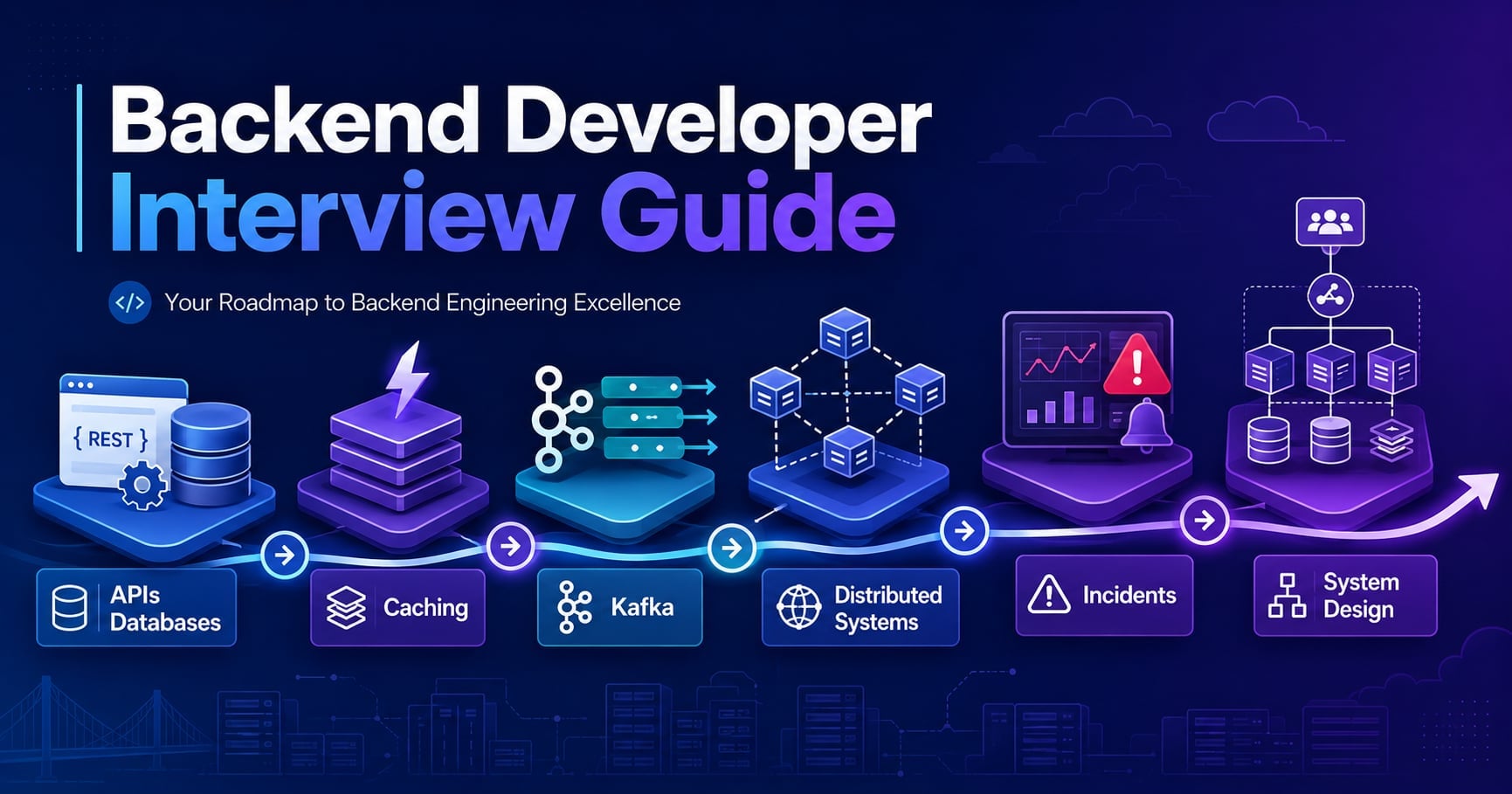
Imagine an interviewer asks you to design a checkout API. You know HTTP, SQL, and Spring Boot, but the conversation quickly becomes harder: What happens when the client retries? What if inventory changes between the read and the write? Where do retries stop? Which data can be stale?
That is the gap this backend developer interview guide closes. It organizes backend preparation around the decisions that show up in real services: API contracts, data correctness, latency, failure containment, and system design. Start with how APIs work if request/response flow is still new; otherwise, use the paths below to turn familiar concepts into interview-ready reasoning.
Table of Contents
Open Table of Contents
What Backend Interviews Actually Test
Backend interviews are not a vocabulary test. An interviewer may ask what an index, cache, or queue is, but the stronger signal is whether you can choose one under constraints and explain what it costs. A useful answer starts with the workload: reads versus writes, latency target, data value, expected failures, and the consistency the user actually needs.
For example, saying “use Redis” for a slow endpoint is incomplete. A production-minded answer asks whether the endpoint is read-heavy, whether stale results are acceptable, what invalidates the key, and what happens if Redis is unavailable. The same habit carries into database transactions, queues, rate limits, and full system designs.
This guide focuses on six capabilities:
- Explain a component precisely without hiding behind jargon.
- State assumptions before proposing an architecture.
- Make trade-offs explicit: latency versus consistency, simplicity versus flexibility, and cost versus resilience.
- Recognize concurrency and partial-failure paths.
- Use observability to debug a live system rather than guessing.
- Communicate a design in a structured way that an interviewer can follow.
How to Use This Guide
Pick the path that matches your current experience. Do not wait to finish every topic before attempting a scenario; the scenario reveals why the concepts matter. Return to the underlying article whenever a decision feels hand-wavy.
flowchart TD
    A[Learn one concept] --> B[Explain why it exists]
    B --> C[Apply it to a failure scenario]
    C --> D[Design a complete system]
    D --> E[Review trade-offs and gaps]
    E --> A
Junior backend path
Build confidence in HTTP, REST, authentication, SQL, indexes, transactions, and basic caching. Practice explaining a request from browser to database and back. The goal is not to memorize every status code; it is to know why a 409 Conflict differs from a validation error and why a request might be safe to retry.
Mid-level backend path
Add isolation levels, locking, pagination, rate limiting, queues, Redis, retries, timeouts, and service boundaries. At this level, interviewers often care less about the definition of a queue than about how your worker handles duplicate messages or a poison job.
Senior backend path
Go deeper on capacity estimates, replication lag, sharding, observability, backpressure, distributed locks, Sagas, and multi-region trade-offs. Practice framing the simplest acceptable design first, then scaling only where the stated numbers require it.
The Backend Interview Roadmap
1. Fundamentals and API design
Start by being able to trace a request. A client calls an API, the service authenticates and authorizes the caller, validates input, executes business logic, persists state, and returns a stable response contract. That sounds ordinary, but most later interview problems are variations on it.
Study these existing foundations in order:
- Client-server architecture for the request path.
- REST APIs and HTTP methods for interface semantics.
- HTTP status codes and REST API error handling for failure contracts.
- Authentication versus authorization and how JWT works for identity and access decisions.
The next API-design articles in this series cover gateways, rate limiting, idempotency, pagination, versioning, and webhooks. They belong together because an API is more than a route and a JSON response. It is a contract that must tolerate retries, misuse, version changes, and downstream failure.
2. Databases and data correctness
Database questions separate “it worked in a demo” from “it remains correct under load.” Learn the relational basics, then focus on the decision points: which queries need indexes, which writes need a transaction, and which concurrent updates must detect conflict.
SQL versus NoSQL is a design choice driven by access patterns and correctness needs, not a slogan about vertical or horizontal scaling. Database indexes speed selected reads but add write and storage cost. ACID properties and transactions define what one database can protect; later articles on isolation, locking, replication, and sharding explain where those guarantees become more nuanced.
When you study each topic, use one concrete example: a customer buys the last item, a payment request is retried, or a report query becomes slow at 100 million rows. The example forces you to explain the concurrency boundary, not just name a feature.
3. Caching and performance
Caching is useful when recomputing or refetching data is more expensive than serving an acceptably fresh copy. It is not the system of record by default. Begin with what caching is and in-memory versus distributed cache, then learn cache-aside, invalidation, eviction, stampede prevention, and Redis architecture.
Performance work also includes database connection pooling, CDNs, and query diagnosis. A fast median response is not enough: tail latency, pool exhaustion, and cache-miss storms often determine the user experience during an incident.
4. Messaging and asynchronous systems
Use asynchronous work when the caller should not wait for a slow or independent task, such as sending an email, resizing an image, or processing an event. Message queues and background jobs provide the entry point.
The next layer is Kafka and event processing: producer/consumer roles, partitions, consumer groups, offsets, delivery guarantees, ordering, lag, and dead-letter queues. The critical interview insight is that an at-least-once system can deliver the same event again. Consumers need idempotent behavior, observability, and a recovery path; “exactly once” is never a substitute for understanding the boundary being protected.
5. Reliability and distributed systems
Scaling adds machines, but reliability is about preserving useful behavior while some of those machines, networks, or dependencies fail. Review load balancing, horizontal versus vertical scaling, reverse proxies, and high availability before moving to circuit breakers, timeout budgets, retries with jitter, health checks, traces, and backpressure.
Distributed-systems questions then ask what happens when independent components cannot agree instantly. CAP, consistency models, distributed locks, leader election, quorum, two-phase commit, and the Saga pattern are tools for reasoning about that reality. The best answer identifies the user-visible invariant first. For checkout, it may be “do not charge a customer twice”; for a feed, it may be “show a recent result quickly even if it is briefly stale.”
6. Scenarios and system design
Concept pages build vocabulary. Scenario pages make you use it. Start with a duplicate payment, last-item inventory race, slow API, Redis failure, Kafka lag, or downstream timeout. For each one, say what you would measure, what you would change first, and why a tempting shortcut fails.
Then practise full system designs. The existing rate limiter design, URL shortener design, and notification system design are useful starting exercises. They connect individual mechanisms - counters, caches, queues, data models, retries, and rate limits - into a complete answer. Browse more interview-design material under the System Design tag.
A Practical Study Loop
Use a short loop for every topic instead of reading a large backlog passively:
- Read one concept and write a two-sentence explanation without looking at the page.
- Draw its request or data flow from memory.
- Change one constraint: higher write volume, a duplicate request, a network timeout, or stale data.
- Explain the new failure mode and the smallest design change that addresses it.
- Answer one follow-up aloud in two minutes.
This loop develops retrieval and judgment. A candidate who can recover from a follow-up question calmly is more convincing than one who can recite an idealized architecture.
How to Answer a Backend Design Question
Use this order for both focused scenarios and open-ended system-design interviews:
- Clarify the job. Ask for core user action, scale, latency, availability, and consistency requirements.
- State assumptions. Use round numbers and say they are assumptions. For example, 10,000 requests per second and 99.9% availability.
- Offer the simplest viable design. Client, API, service, primary data store, and the request flow come first.
- Identify the hard part. Duplicate payment, hot key, ordering, or replica lag - not every component deserves equal depth.
- Discuss failure paths. Timeouts, retries, partial writes, overload, and recovery must have an owner.
- Add scale deliberately. Introduce caching, queues, partitions, replicas, or shards only when the workload calls for them.
- Name the trade-off. Every choice should answer what becomes slower, costlier, less consistent, or more complex.
A 6-Week Preparation Plan
Use this as a repeatable sprint, not a promise that six weeks fits every interview process.
| Week | Focus | Practice outcome |
|---|---|---|
| 1 | HTTP, REST, authentication, API errors | Explain a secure CRUD API and retry semantics. |
| 2 | SQL, indexes, transactions, isolation | Diagnose a slow query and protect a concurrent write. |
| 3 | Caching, Redis, connection pools | Design a read path with invalidation and cache-failure behavior. |
| 4 | Queues, Kafka, delivery guarantees | Explain duplicate delivery, lag, retries, and DLQ recovery. |
| 5 | Reliability, observability, distributed systems | Debug a latency spike and contain a dependency failure. |
| 6 | Scenarios and system design | Run timed mock interviews and revise the weak concepts they reveal. |
Spend the final session of each week on explanation, not reading. Record a five-minute answer, then listen for missing assumptions, unexplained components, and claims such as “this scales” with no numbers behind them.
Common Interview Traps
”CAP means pick any two”
The useful question is what the system does during a network partition. It may need to prefer a consistent answer or remain available with potentially stale or conflicting state. Treating CAP as a permanent menu of three features loses the failure context that makes the theorem useful.
”A POST request is never idempotent”
HTTP method semantics alone do not settle business behavior. A payment endpoint can accept an idempotency key and return the first completed result on a retry. Conversely, a poorly designed update endpoint can create duplicate effects. Explain the end-to-end operation and the durable deduplication boundary.
”Add a cache”
Ask what the cache contains, its TTL, invalidation owner, acceptable staleness, and fallback behavior. A cache can protect a database, but it can also create an outage amplification path when a popular key expires everywhere at once.
”Use microservices to scale”
Service decomposition can let teams deploy and scale a hot capability independently. It also adds network calls, operational overhead, distributed data concerns, and more failure modes. A modular monolith is often the better starting point until independent scaling or ownership has a clear payoff.
Production Reality: Design for Failure, Not Just Features
An endpoint that works in a happy-path test is only the beginning. Suppose a checkout request times out after the payment provider processes it. The client may retry, the application may retry, and a webhook may later arrive. A reliable design needs a durable idempotency record, a transaction boundary for local state, a reconciliation path for provider state, and monitoring that exposes unresolved payments.
That pattern generalizes. Before recommending a technology, identify the invariant and failure boundary. A database unique constraint can protect a local identity; a queue can absorb temporary load; a circuit breaker can keep a failing dependency from consuming all request threads. None of them removes the need to decide what the user should see when the system is uncertain.
Conclusion
- Backend preparation is a progression from concepts to failure scenarios to complete designs.
- APIs, databases, caching, and messaging matter because they protect user-visible invariants under real constraints.
- Strong interview answers state assumptions, choose the simplest design, and explain the trade-offs.
- Retries, timeouts, duplicates, overload, and stale reads deserve first-class treatment.
- Practising explanations and follow-ups is more valuable than collecting isolated definitions.
The next topic in this series covers API gateway architecture and trade-offs - how routing, authentication, rate limiting, and aggregation fit at the edge of a backend system. For a useful prerequisite, revisit what a reverse proxy does and compare its role with a gateway during your study session.
References
- HTTP Semantics - IETF RFC 9110
https://www.rfc-editor.org/rfc/rfc9110 - Building Secure and Reliable Systems - Google SRE
https://sre.google/books/building-secure-reliable-systems/ - OWASP API Security Project - OWASP Foundation
https://owasp.org/www-project-api-security/
YouTube Videos
- “System Design Interviews - Backend | How to prepare for System Design Interviews?“
https://www.youtube.com/watch?v=oxPFcV6Tqmk - “Complete Backend Developer Roadmap | How to get hired as Backend Developer”
https://www.youtube.com/watch?v=QUcC1RB8vy0