 ADevGuide
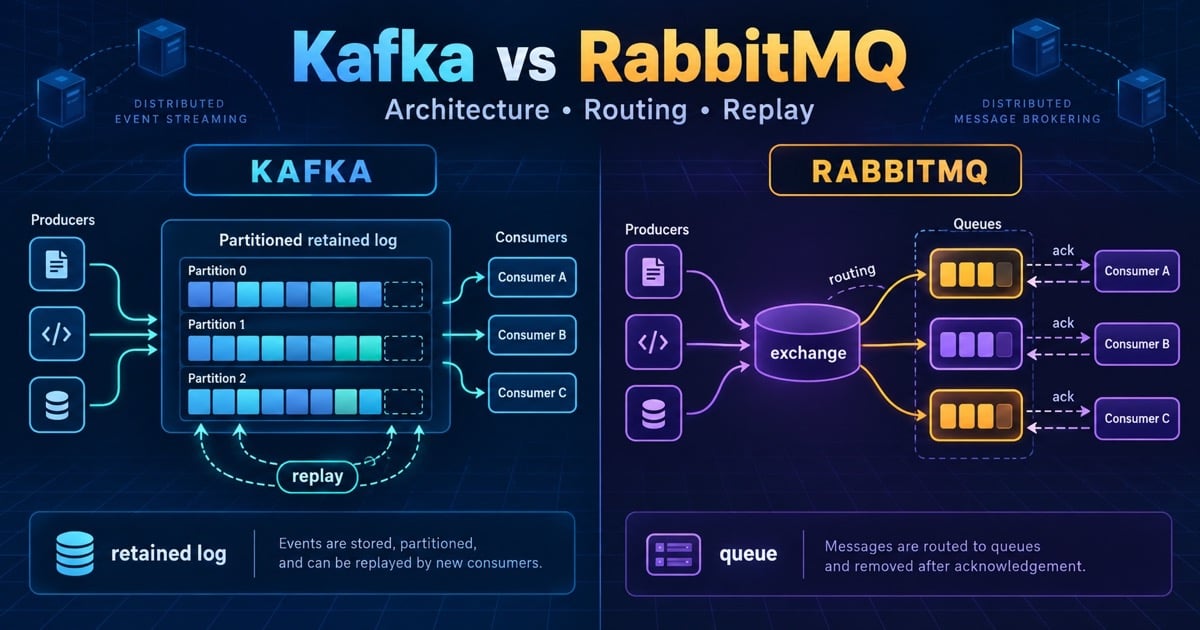
A team needs to deliver invoice work to one worker today, replay billing events next month, and route urgent notifications to different services. Kafka and RabbitMQ can both move messages, but choosing based on a generic “throughput” chart misses the real decision: do you need a retained event log, a smart work broker, or both?
This Kafka vs RabbitMQ comparison explains the underlying models, delivery and ordering behavior, routing, retention, replay, scaling, operations, and the use cases each system fits best. Read queue vs pub/sub for the messaging contract first, then use Kafka architecture and what is a message queue for the surrounding concepts. The Backend Interview Mastery series provides the learning path, and the Backend tag collects related articles.
Table of Contents
Open Table of Contents
- The Short Answer
- Kafka and RabbitMQ Use Different Core Models
- Architecture and Data Flow
- Retention, Replay and Acknowledgements
- Ordering and Parallelism
- Routing and Messaging Patterns
- Throughput, Latency and Scaling
- Operations, Reliability and Cost
- When to Choose Kafka, RabbitMQ or Both
- Production Decision Examples
- Interview Questions
- Conclusion
- References
- YouTube Videos
The Short Answer
Choose Kafka when the durable history is part of the product: several independent consumers need the same stream, consumers must replay from offsets, or the workload is a long-running event pipeline. Choose RabbitMQ when the broker should route individual work items, support acknowledgements and redelivery, or provide flexible exchange, queue, priority, and request-reply patterns with a straightforward work-queue mental model.
That summary is useful but no longer absolute. RabbitMQ also provides durable Streams, and recent Kafka versions add queue-like share groups. Compare the exact feature and operating mode, not only the product name.
| Requirement | Stronger default | Reason |
|---|---|---|
| Replay a retained event history | Kafka | Consumers keep offsets and reread retained records |
| Route work by headers, topic keys, or fanout | RabbitMQ | Exchanges route messages to queues |
| Many independent consumers of one history | Kafka | Consumer groups read the same log independently |
| One task should be owned and acknowledged | RabbitMQ | Queue delivery and acknowledgements model work directly |
| High-volume event pipelines and stream processing | Kafka | Partitions, batching, retention, and Kafka Streams fit the workload |
| Complex per-message TTL, priority, or delayed delivery | RabbitMQ | Queue features operate on individual messages |
| Already have both event streaming and task workflows | Both | Keep the boundary explicit and bridge with an idempotent consumer |
The right answer is a workload decision. “Kafka is faster” or “RabbitMQ is simpler” is incomplete without message size, fan-out, replay, ordering, latency, failure, and operational constraints.
Kafka and RabbitMQ Use Different Core Models
Kafka is a distributed append-only log. Producers write records to topic partitions, and each consumer group tracks a position in the retained log. Consuming a record does not remove it; retention or compaction determines when the broker can reclaim storage. This makes replay, independent consumer speed, and event history first-class concepts.
RabbitMQ is a message broker built around exchanges, queues, bindings, and acknowledgements. A producer publishes to an exchange, the exchange routes to one or more queues, and consumers acknowledge deliveries. Classic and quorum queues represent work items whose lifecycle is tied to acknowledgement, while RabbitMQ Streams add a retained log with offsets for streaming workloads.
flowchart TD
    A[Producer] --> B[Kafka topic]
    B --> C0[Partition 0]
    B --> C1[Partition 1]
    C0 --> D[Consumer group: billing]
    C1 --> D
    B --> E[Consumer group: analytics]
    C0 --> E
    C1 --> E

    F[Producer] --> G[RabbitMQ exchange]
    G -->|routing key| H[Orders queue]
    G -->|fanout binding| I[Audit queue]
    H --> J[Worker]
    I --> K[Audit consumer]
The model changes what “success” means. Kafka success is usually “the record is durably appended and the consumer’s offset advances after its effect.” RabbitMQ success is usually “the broker delivered the message and the consumer acknowledged it.” RabbitMQ Streams and Kafka can both provide log-like replay, but their client APIs, routing, and operational controls remain different.
Architecture and Data Flow
Kafka flow
- A producer chooses a topic and, usually, a partition key.
- The broker appends the record to a partition and replicates it according to the topic policy.
- Each consumer group reads the partition at its own offset.
- The consumer commits progress after its chosen durable effect.
- Other groups can independently replay or process the same history.
Kafka’s scaling unit is the partition. The Kafka partitions guide explains why a key preserves per-entity order but can create a hot partition.
RabbitMQ flow
- A producer publishes a message to an exchange with properties and a routing key.
- Bindings route the message to one or more queues.
- A consumer receives the message, often through push delivery with a prefetch limit.
- The consumer acknowledges, rejects, or negatively acknowledges the delivery.
- The broker removes, requeues, dead-letters, or redelivers it according to the queue policy.
The routing layer is a major reason to choose RabbitMQ. A topic exchange can route events to matching queues, a fanout exchange can broadcast to every bound queue, and a direct exchange can route an exact key. Kafka topics can support fan-out through consumer groups, but content-based routing is normally application logic or a stream-processing topology.
Retention, Replay and Acknowledgements
Kafka retention is independent of consumption. A group can stop for an hour, resume from its committed offset, and replay records as long as they remain within the retention boundary. A second group can start from the beginning or a timestamp without affecting the first group. This is ideal for rebuilding a search index, reprocessing analytics, or recovering a new service.
RabbitMQ queues normally hold a message until it is acknowledged, rejected, expired, or dead-lettered. That is a strong fit for work completion, but it is not the same as a shared historical log. RabbitMQ Streams provide non-destructive reads and retention, so they can cover replay use cases; the decision then becomes whether the Stream protocol and ecosystem fit the pipeline.
| Concern | Kafka | RabbitMQ queues | RabbitMQ Streams |
|---|---|---|---|
| Progress marker | Consumer-group offset | Delivery acknowledgement | Stream offset |
| Normal consumption | Record remains until retention | Message leaves after acknowledgement | Record remains until retention |
| Replay | Native seek by offset or timestamp | Requeue or republish; not a general history | Native stream positioning |
| Failure isolation | Retry topic or application DLQ | Reject/requeue and dead-letter exchange | Application or stream error policy |
| Best mental model | Event history | Work item | Retained stream |
Neither system makes an external side effect automatically exactly once. Kafka consumers need the delivery guarantee and offset rules from this series. RabbitMQ consumers need publisher confirms, manual acknowledgements, idempotent handlers, and a clear redelivery policy. For payment or webhook calls, use an idempotency key and reconciliation in either system.
Ordering and Parallelism
Kafka guarantees ordering within a partition. A key such as orderId keeps an order’s events together, while different keys can run on different partitions and consumer members. Adding consumers stops helping when every partition has an owner. Async worker pools can still break business ordering unless the application serializes per key or uses event versions.
RabbitMQ preserves queue order best when one active consumer processes deliveries serially and acknowledgements complete in order. Competing consumers increase work parallelism but can change completion order. Prefetch, redelivery, priorities, retries, and multiple queues can all affect what an application observes. Single active consumer and Streams partitioning provide stronger tools for selected ordering domains, but the contract must be tested for the specific mode.
flowchart TD
    A[Kafka key: order-42] --> B[One Kafka partition]
    B --> C[One active group owner]
    C --> D[Per-order sequence]
    E[Rabbit exchange] --> F[Orders queue]
    F --> G{Competing consumers}
    G --> H[Worker A]
    G --> I[Worker B]
    H --> J[Higher parallelism]
    I --> J
    J --> K[Completion order needs application policy]
If topic-wide ordering is required, Kafka needs one partition and accepts the throughput cost. If queue-wide completion order is required, RabbitMQ needs one active consumer or a keyed routing design. Do not compare “ordering” as a checkbox without naming the scope and the failure behavior.
Routing and Messaging Patterns
RabbitMQ is often the better fit for application messaging patterns:
- Request-reply with correlation IDs and reply queues.
- Work queues with manual acknowledgement and bounded prefetch.
- Fanout, direct, topic, or header-based routing through exchanges.
- Per-message TTL, priority queues, delayed delivery plugins, and dead-letter exchanges.
- Protocol choices such as AMQP, MQTT, STOMP, or JMS where the deployment requires them.
Kafka is often the better fit for event-streaming patterns:
- Multiple independent consumer groups reading the same event history.
- High-volume append and sequential fetch with partition-level parallelism.
- Replay, backfill, compaction, and stream joins or aggregations.
- CDC, telemetry, audit streams, and data-platform pipelines.
- Kafka Streams or compatible stream processors that use offsets and state stores.
The distinction is not “RabbitMQ cannot stream” or “Kafka cannot queue.” RabbitMQ Streams and Kafka share more capabilities than older comparison charts suggest; Kafka share groups and RabbitMQ queue features also overlap. The operational question is which primitive is natural, mature, and easiest for the team to observe and recover.
Throughput, Latency and Scaling
Do not publish a universal messages-per-second winner. Throughput depends on payload size, batching, replication, persistence, consumer work, network, storage, acknowledgement mode, and topology. Benchmark the exact workload with failure enabled, not an empty local broker.
Kafka commonly scales write and read throughput by adding brokers, partitions, and consumer-group members. Batching and sequential disk access make large streams efficient, but the partition count adds metadata, replica, file, and operational overhead. Long retention also makes capacity planning a storage problem.
RabbitMQ queues scale through consumers, prefetch, queue topology, and clustering or quorum policies. Per-message routing and acknowledgement add useful control but can add broker work. Quorum queues trade resources for replicated safety, while Streams provide a log-oriented path for high-volume retained data.
Measure at least:
| Metric | Why it matters |
|---|---|
| End-to-end latency percentiles | User-visible freshness and tail behavior |
| Ingress and consume rate | Whether backlog grows or drains |
| Partition lag or queue depth/age | Work waiting for service |
| Redelivery and retry rate | Failure amplification |
| Broker disk, network, and replication | Durability and saturation |
| Consumer handler time and downstream latency | Actual application bottleneck |
The Kafka consumer lag guide shows why backlog age is more useful than an isolated count. RabbitMQ operators should likewise alert on oldest-message age, unacknowledged messages, redeliveries, and queue growth rather than only total depth.
Operations, Reliability and Cost
Kafka requires careful topic, partition, replication, retention, consumer-group, and schema governance. Its ecosystem is powerful for event platforms, but a small task queue may not need that operational surface. KRaft simplifies modern Kafka metadata management, yet teams still need capacity planning, rebalancing controls, retention policies, and lag observability.
RabbitMQ provides a management UI and a broker model that can be approachable for task delivery, but clustering, quorum queues, exchange topology, memory alarms, flow control, and redelivery storms still require operational discipline. A simple queue is easy to start; a large multi-tenant topology is not automatically simple.
Reliability is a contract in both systems:
- Kafka: producer acknowledgements and idempotence, replicated partitions, committed offsets, retry/DLQ topics, and idempotent sinks.
- RabbitMQ: publisher confirms, durable exchanges and queues, quorum or mirrored durability choices, manual acknowledgements, dead-letter exchanges, and idempotent consumers.
Cost includes people and recovery complexity, not only broker instances. If a team already operates Kafka for event history, adding a small RabbitMQ cluster may be worthwhile for request-reply and task routing. If the only requirement is a modest background job queue, Kafka’s retention and partition machinery may be unnecessary overhead.
When to Choose Kafka, RabbitMQ or Both
Use this decision sequence in a design review:
- Is the message an event history or a unit of work? Choose Kafka for history; RabbitMQ queues for work.
- Must several independent applications replay the same data? Prefer Kafka or RabbitMQ Streams.
- Does routing happen by content, headers, or many dynamic bindings? Prefer RabbitMQ exchanges.
- Is strict per-entity order required at high throughput? Compare Kafka partition keys with RabbitMQ single-active or stream partitioning.
- What is the latency and acknowledgement contract? Test manual acks, confirms, transactions, and redelivery under failure.
- Who will operate retention, replay, DLQ, schema, and capacity? Choose the platform your team can recover at 3 a.m.
Use both only with a deliberate boundary. Kafka can be the durable event backbone, while RabbitMQ handles a command or task workflow that needs rich routing and per-message lifecycle. Bridge them through an idempotent service, include correlation IDs, define ownership, and avoid a bidirectional loop that duplicates business events.
Production Decision Examples
Analytics and search rebuilds
An order event must feed fraud, search, analytics, and a future recommendation service. Kafka is the natural backbone because each consumer group reads the same retained history at its own pace. A search index can be rebuilt from an earlier offset without asking the producer to republish every event.
Image processing jobs
An upload service creates one resize job and needs workers to acknowledge completion, retry transient storage failures, and dead-letter malformed requests. A RabbitMQ queue with manual acknowledgement, prefetch, and a dead-letter exchange maps directly to that work lifecycle. Kafka could implement the workflow, but its retained-log model would add machinery the job does not need.
Hybrid order platform
The order service publishes durable domain events to Kafka. A notification service consumes those events and publishes short-lived email tasks to RabbitMQ because each task needs routing, provider-specific queues, rate limits, and per-message retry. The bridge stores an event ID and task ID so a crash cannot create duplicate notifications.
Interview Questions
1. What is the fundamental difference between Kafka and RabbitMQ?
Kafka is primarily a distributed, retained append-only log where consumer groups track positions. RabbitMQ is primarily a broker that routes individual messages through exchanges and queues with acknowledgements. RabbitMQ Streams and Kafka queue-like features narrow the gap, so I still ask whether the workload needs retained history, rich routing, or a task lifecycle.
2. Which one has higher throughput?
There is no honest universal number. Kafka often excels at large batched streams because partitions and sequential fetch scale across brokers, while RabbitMQ can be excellent for low-latency routed work and also offers Streams for high-volume data. I benchmark the message size, durability, acknowledgement mode, fan-out, and consumer work that the production system will actually use.
3. How do ordering guarantees differ?
Kafka orders records within a partition, commonly selected by a message key. RabbitMQ can preserve queue order with one active serial consumer, but competing consumers, redelivery, priority, and multiple queues change completion order. I define the business ordering scope first, then select partition keys or queue topology to enforce it.
4. How do replay and retention differ?
Kafka retains records independently of consumption and lets a group seek to an offset or timestamp while retention allows. RabbitMQ queues normally remove acknowledged work, so replay requires republishing or requeueing; RabbitMQ Streams provide an offset-based retained log. The correct choice depends on whether history is a core product requirement.
5. When would you use both?
I use Kafka for durable domain events, fan-out, replay, and analytics, then RabbitMQ for a task workflow that needs exchange routing, per-message acknowledgement, priority, or delayed delivery. The bridge must be idempotent, observable, and one-directional for each business transition. Otherwise two brokers only multiply failure and ownership boundaries.
6. Is RabbitMQ simpler to operate than Kafka?
It can be simpler for a small work queue because exchanges, queues, consumers, and acknowledgements map directly to the problem. Large RabbitMQ clusters still require quorum, flow-control, memory, topology, and redelivery expertise, while Kafka requires partition, retention, replication, and lag expertise. Operational simplicity is workload- and team-dependent, not a product guarantee.
Conclusion
Kafka vs RabbitMQ is a choice between dominant mental models: a replayable event log and a routed message broker. Kafka is a strong default for retained streams, independent consumer groups, and data pipelines. RabbitMQ is a strong default for task delivery, routing, acknowledgements, and request-reply workflows. Modern RabbitMQ Streams and Kafka queue semantics create overlap, so choose the exact operating mode that makes your ordering, failure, replay, and ownership contracts easiest to enforce.
References
YouTube Videos
- “Kafka vs RabbitMQ” - Hello Interview [https://www.youtube.com/watch?v=1HOVtQ-_fcE]