 ADevGuide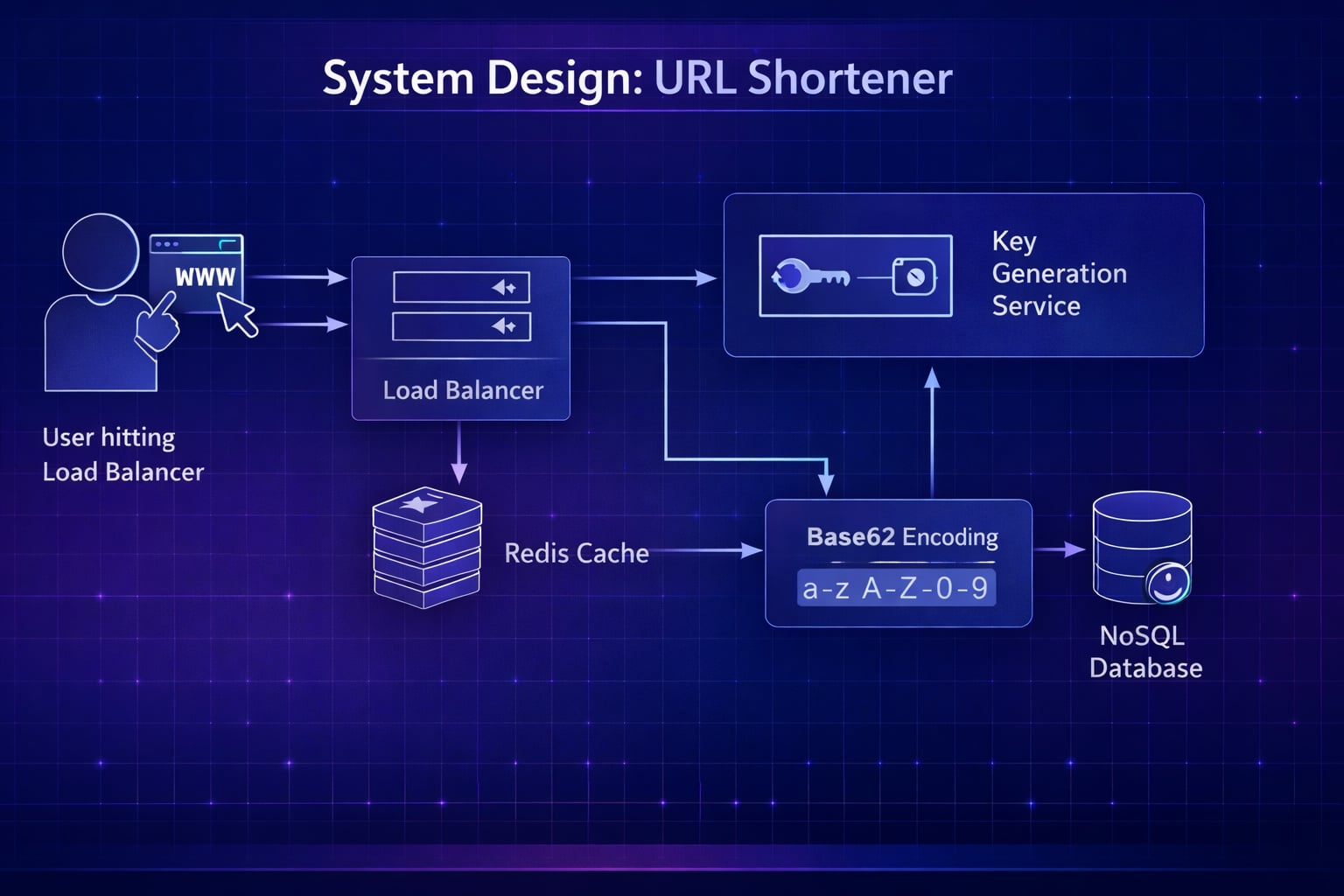
This is a quick-reference companion for the full deep-dive post. Read the complete walkthrough here: System Design Interview: Full Guide.
Table of Contents
Open Table of Contents
How to Use This CheatSheet in an Interview
- Start with requirements (2-3 minutes).
- Draw high-level architecture (5-7 minutes).
- Pick the hardest sub-problem and go deep.
- Close with scale, failures, and trade-offs.
One-Minute Requirements Checklist
- Clarify functional scope and APIs.
- Confirm latency, availability, and consistency targets.
- Ask for DAU/MAU, peak concurrency, and growth assumptions.
- Confirm security/compliance expectations.
Core Architecture Snapshot
flowchart TD
  A[Client] --> B[API Gateway]
  B --> C[Core Service]
  C --> D[Cache Layer]
  C --> E[Primary DB]
  C --> F[Queue/Stream]
F --> G[Async Workers]- Keep writes authoritative in the primary service/database.
- Use cache for read-heavy access paths.
- Push asynchronous work to queues/workers.
Critical Trade-Offs to Say Out Loud
- Latency vs consistency (eventual consistency is often acceptable for feeds/analytics).
- Simplicity vs flexibility (single store now, polyglot persistence later).
- Cost vs reliability (multi-region and replication increase spend).
Capacity Planning Quick Math
- Start from peak QPS, not average QPS.
- Compute write/read split and identify the dominant path.
- Add 2x headroom for spikes and failure events.
- Estimate storage for 1 day, 1 month, and 1 year.
Failure Cases to Mention
- Region outage and failover strategy.
- Queue backlog growth and retry/dead-letter handling.
- Cache stampede and hot partition mitigation.
- Partial writes and idempotency safeguards.
Rapid-Fire Follow-Up Answers
- How do you scale reads? Add cache + read replicas + CDN where applicable.
- How do you scale writes? Partition by a stable key and isolate hot shards.
- How do you keep data safe? Multi-AZ replication, backups, and restore drills.
- How do you handle abuse? AuthN/AuthZ, rate limiting, and anomaly detection.
- What would you improve next? Better observability and adaptive autoscaling.
Related Deep Dive
- Full post: System Design Interview: Full Guide
YouTube Videos
-
“System Design Interview: Designing a URL Shortener (like Bitly) | Step-by-Step Guide” https://www.youtube.com/watch?v=6-35QC8PvqM
-
“TinyURL System Design | URL Shortner System Design Interview Question | Bitly System Design” https://www.youtube.com/watch?v=AVztRY77xxA
-
“Ep 1 · Design a URL Shortener — A Full Mock System Design Interview” https://www.youtube.com/watch?v=4DoYqJhXHV4