 ADevGuide
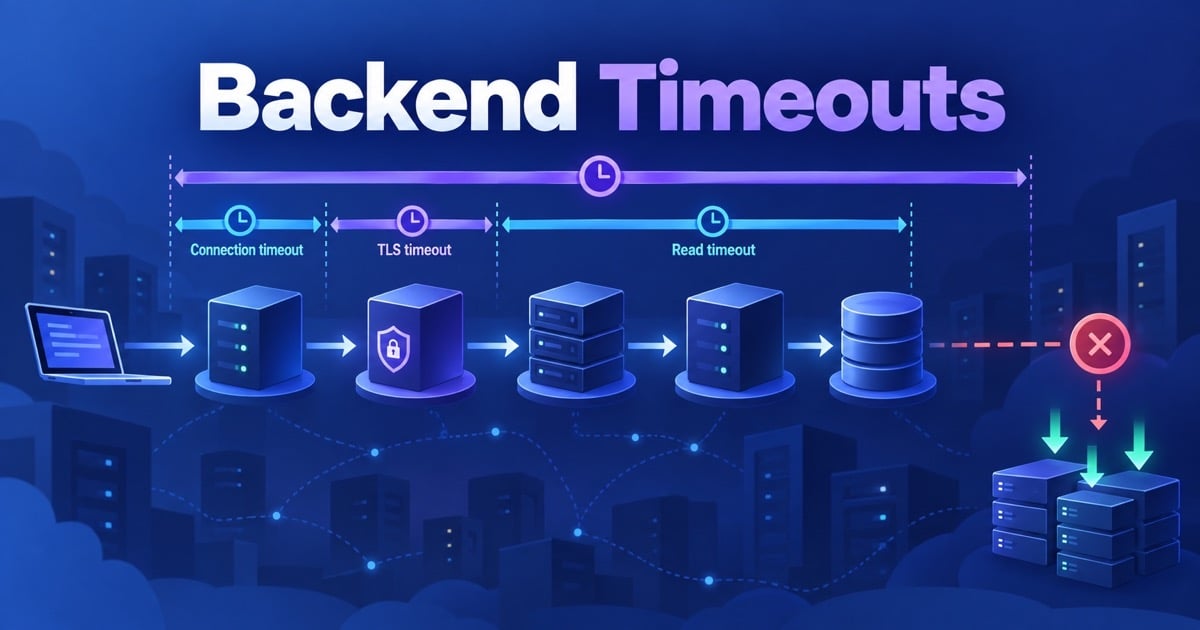
An HTTP client without a timeout can hold a thread, socket, and database connection until the operating system gives up. A timeout that is too short fails healthy work; one that is too long lets a partial outage consume every resource. Backend timeouts are an explicit budget for how long a system is willing to wait.
This guide separates connection, TLS, write, read, request, and idle timeouts, then shows how to propagate one deadline through services. Continue from circuit breakers, retries with jitter, and connection pooling.
Table of Contents
Open Table of Contents
Timeouts Are Resource Budgets
flowchart TD
    A[Incoming request deadline] --> B[API handler budget]
    B --> C[Connection and TLS budget]
    C --> D[Write request budget]
    D --> E[Read response budget]
    E --> F[Downstream result]
    B -->|Budget exhausted| G[Cancel and release resources]
A timeout should cancel work and release resources, not merely return an error to the caller while the operation continues in the background. Make cancellation observable: track requests that finish after the caller deadline and verify that pooled connections are returned.
Timeout Types
| Timeout | Protects | Common failure it exposes |
|---|---|---|
| DNS lookup | Resolver wait | Broken resolver or stale network path |
| Connect | TCP/TLS establishment | Unreachable host or saturated listener |
| Write | Uploading request bytes | Stalled socket or backpressure |
| Read | Waiting for response bytes | Slow handler or blocked downstream |
| Total request | End-to-end caller budget | Cascading latency across hops |
| Idle | Long-lived stream silence | Dead connection or missing heartbeat |
Do not set only a total timeout for a client that opens connections under load. A connect stall can consume the entire budget and leave no useful diagnostic. Conversely, independent per-phase timers can exceed the total request deadline unless they share a context.
Deadline Propagation
Pass the remaining deadline in the request context or an explicit header such as grpc-timeout. A downstream service should use the smaller of its local safety limit and the propagated deadline. It must stop work when cancellation arrives, including database queries, outbound calls, and queue waits.
If a request enters with 800 ms, reserve time for response serialization and network return. Perhaps the API gives 650 ms to an inventory call, 100 ms to local work, and 50 ms to return. These values are workload-specific; the important rule is that every hop knows the remaining budget instead of starting a fresh 1-second clock.
Choosing Values
Choose timeouts from latency percentiles and failure cost, not a round number copied from another service. A read timeout just above the dependency’s normal P99 can catch pathological tails while avoiding false failures, but it needs margin for network variance and deploys. Measure by operation and payload size; an upload and a point read need different budgets.
Use longer timeouts for asynchronous job processing only when the worker lease and heartbeat are designed for it. A message visibility timeout shorter than the handler causes duplicate work; one much longer than the handler delays recovery from a crashed worker.
Timeouts, Retries and Idempotency
A timeout makes the result ambiguous. The server may have completed the operation even though the client stopped waiting. Retrying a read is usually safe; retrying a write needs an idempotency key or a transactional state check. Idempotency in REST APIs covers the durable key pattern.
Never let every layer retry until its own timeout expires. If a top-level deadline is 1 second and three nested services each retry for 1 second, the system can keep doing work after the user has gone away. Combine deadlines, bounded retries, and circuit breakers to fail quickly under sustained dependency failure.
Implementation Sketch
const controller = new AbortController();
const timeout = setTimeout(() => controller.abort(), 800);

try {
  const response = await fetch(paymentUrl, {
    signal: controller.signal,
    headers: { "x-request-deadline-ms": String(Date.now() + 800) },
  });
  if (!response.ok) throw new Error(`payment status ${response.status}`);
  return await response.json();
} finally {
  // Always clear the timer so completed requests do not retain a callback.
  clearTimeout(timeout);
}
Production clients should configure connect, TLS, pool-acquisition, read, and total deadlines separately where the library allows it. They should also cancel the server-side work when the context closes; returning an error without cancellation is not timeout safety.
Interview Questions
1. What is the difference between a connection and read timeout?
A connection timeout limits how long the client waits to establish a socket and TLS session. A read timeout limits how long it waits for response bytes after the request is sent. They diagnose different failures and should be measured separately even when a client also has a total request deadline.
2. How do you choose a timeout value?
Start with the operation’s latency distribution, SLO, payload, and failure cost, then validate under load and partial failure. Set a total deadline first and allocate smaller budgets to each hop. Revisit values when dependency latency or traffic shape changes.
3. Why can a timeout cause duplicate payments?
The client may stop waiting while the provider continues and completes the charge. A retry can then create a second charge unless the provider or a durable local record deduplicates by idempotency key. Timeout handling must therefore include the unknown-outcome path.
4. Should retries have a longer timeout than the original request?
No. Retries must fit inside the original deadline or an explicit asynchronous recovery contract. A downstream attempt that outlives the caller consumes resources for work nobody is waiting for and can amplify load during an outage.
5. How do timeouts prevent cascading failure?
They cap how long threads, sockets, and pool entries remain occupied. Combined with cancellation, bounded retries, and circuit breakers, they stop a slow dependency from filling every resource in its callers. A timeout alone is not enough if the underlying work continues after the response fails.
Conclusion
Timeouts are explicit latency and resource budgets. Separate phases, propagate one deadline, cancel work, choose values from measured percentiles, and treat timed-out writes as ambiguous. The combination of timeouts, idempotency, bounded retries, and circuit breakers keeps a slow dependency from becoming a system-wide outage.
References
- AWS Builders’ Library: Timeout, retries, and backoff with jitter
- gRPC: Deadlines
- Google SRE Book: Handling overload
YouTube Videos
- “Timeouts, Retries and Backoff in Distributed Systems” - AWS Architecture [https://www.youtube.com/watch?v=rvKKj7JU92g]