 ADevGuide
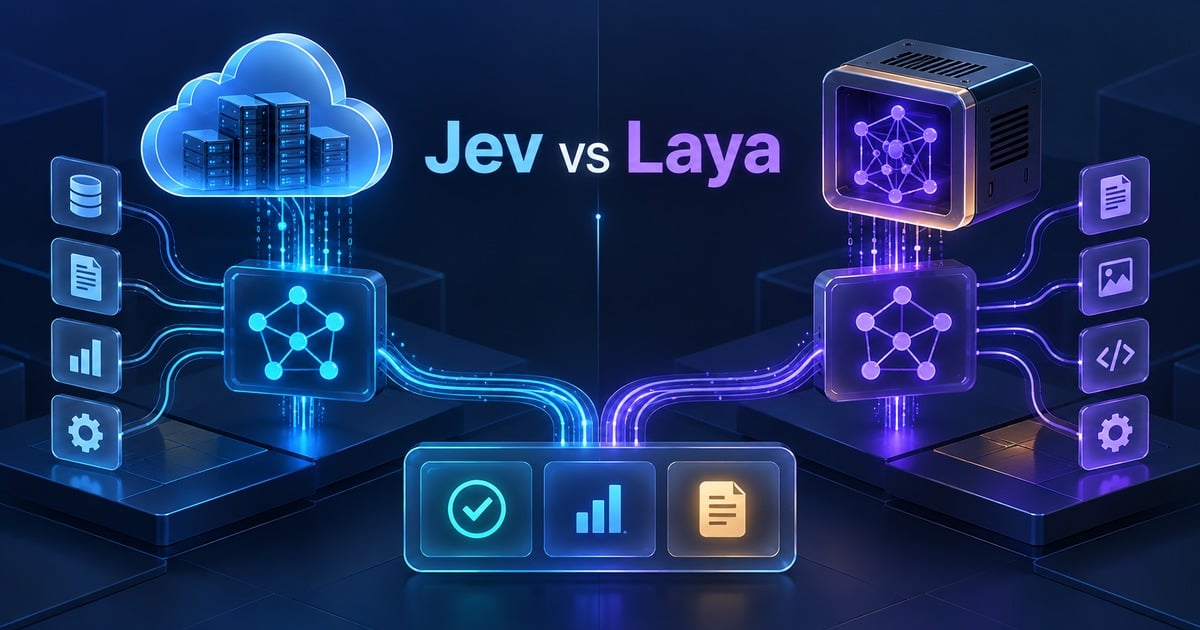
Jev and Laya are part of a new category of AI systems built for software decisions instead of open-ended chat. Both accept state and typed questions, then return bounded choices, scores, or yes-or-no probabilities. That makes them interesting for routing, guardrails, classification, and agent workflows.
The important difference is not simply which model is faster. Jev is a hosted TypeSafe AI product with a managed API and a proprietary model. Laya is an open-source model family designed for local inference, multilingual routing, and developer control. This Jev vs Laya comparison explains those trade-offs so you can choose based on deployment constraints, workload shape, and operational capacity. For the surrounding ecosystem, browse the AI Engineering hub, the LLM agents hub, and our guides to reducing LLM costs and AI agent skills.
Last Updated: September 22, 2026
Table of Contents
Open Table of Contents
- Jev vs Laya at a Glance
- What Both Models Have in Common
- The Main Differences Between Jev and Laya
- Jev vs Laya Feature Comparison
- Choosing Jev
- Choosing Laya
- A Hybrid Architecture
- How to Run a Fair Evaluation
- Decision Guide by Use Case
- Frequently Asked Questions (FAQs)
- Conclusion
- References
- YouTube Videos
Jev vs Laya at a Glance
The short answer is simple:
- Choose Jev when you want a managed decision API, a focused developer experience, and minimal model operations.
- Choose Laya when you need open weights, local or air-gapped inference, multilingual routing, or the ability to fine-tune and own the deployment.
- Choose a hybrid when some decisions need managed reliability and others need local control.
| Dimension | Jev | Laya |
|---|---|---|
| Maker | TypeSafe AI | Convai Innovations |
| Model category | System One decision model | Open-source System 1 decision model family |
| Primary interface | Hosted API | Local Python package and model checkpoints |
| Output | Choice, Score, or Noul-style typed decisions | Choice, Score, or Noul-style typed decisions |
| Availability | Early-access managed service | Open weights and self-hosted deployment |
| Language strategy | Current documented interface accepts text state | English, multilingual, and typed-decision checkpoints with routing |
| Cost model | Metered hosted API | No per-request API bill, but you pay for compute and operations |
| Model ownership | Proprietary hosted model | Apache 2.0 open weights and code as published by the project |
| Best fit | Fast integration and managed infrastructure | Privacy, control, multilingual local inference, customization |
The table is a starting point, not a benchmark result. The models are not interchangeable drop-ins, and the best choice depends on the questions you ask, the languages in your data, the number of options, and the cost of operating the entire workflow.
What Both Models Have in Common
They return decisions instead of prose
Both models target the same interface problem: software should not have to parse a paragraph to recover a small decision. You define the acceptable shape, and the model returns a value inside that shape.
They use bounded question types
Choice works for selecting a category. Score works for ordered levels. Noul works for a yes-or-no probability. These primitives encourage developers to decompose a vague prompt into explicit judgments.
They complement generative LLMs
Neither model is a general-purpose chatbot. A larger LLM can write the final message, summarize a document, or plan a complex tool sequence. Jev or Laya can make the fast routing decisions around that work.
They still require evaluation
Constrained output prevents schema drift, but it does not guarantee a correct judgment. The surrounding system needs representative test data, thresholds, calibration checks, monitoring, and a fallback for uncertainty.
The Main Differences Between Jev and Laya
Deployment and Ownership
Jev is designed as a hosted TypeSafe AI service. You send a request to the API, receive a structured answer, and let TypeSafe manage the model infrastructure. This is attractive when the team wants to integrate quickly and does not want to maintain GPU workers or model artifacts.
Laya is designed to run from published checkpoints and a Python package. You can deploy it in your own environment, keep data inside a private network, and change the serving stack. That control comes with work: model downloads, memory sizing, health checks, rollouts, capacity planning, logging, and incident response become your responsibility.
This is a classic managed-service versus self-hosted trade-off. Managed Jev reduces operational surface area but increases provider dependency. Local Laya increases control and portability but moves infrastructure work to your team.
Language and Checkpoint Strategy
Jev’s current documented interface focuses on text state and typed questions. If your application is primarily English and the decision task fits the API, this can be a simple path.
Laya offers separate checkpoints for English, multilingual input, and typed-decision workflows, with a router that selects among them. That is useful for global applications, but it also makes routing part of the correctness story. A language detector that chooses the wrong checkpoint can produce confident but poor results.
Do not choose based only on the phrase “100-plus languages.” Test the scripts, dialects, domains, and code-switching patterns in your actual traffic. Language coverage is not the same as equal accuracy or calibration in every language.
Speed and Cost
TypeSafe’s launch material reports Jev end-to-end latency in a 70 to 500 millisecond range and an input price of $0.042 per million tokens, with output tokens reported as free for decision results.
Convai Innovations reports a 32.8 millisecond median for a single Laya question on a single GPU and 7.2 milliseconds per question for a ten-question batch. The Laya project also frames self-hosted inference as having no per-request API fee.
These figures are not apples-to-apples. Jev’s number includes a hosted API path. Laya’s number depends on local hardware, model loading, batch size, and serving configuration. A fair cost comparison includes:
- GPU or CPU rental and utilization.
- Power, storage, and network cost.
- Engineering time for deployment and upgrades.
- Monitoring, on-call coverage, and incident recovery.
- Data egress and provider fees for the rest of the workflow.
- The cost of mistakes, retries, escalations, and missed recalls.
Accuracy and Calibration
Both projects emphasize calibrated decisions, but benchmark numbers depend on the evaluation setup. Laya’s official comparison reports results against Jev and other baselines, while TypeSafe publishes its own workflow evaluations and caveats. Those results are useful signals, not a substitute for a matched test on your own data.
Calibration is especially important when the application uses thresholds. A model that is accurate on average but overconfident on a rare class can be dangerous in a guardrail or security workflow. Measure calibration by class, language, confidence band, and model version.
Jev vs Laya Feature Comparison
| Feature | Jev | Laya | What it means for a developer |
|---|---|---|---|
| Managed API | Yes | No, self-host by default | Jev is faster to integrate; Laya gives more deployment control |
| Open weights | No | Yes, as published by Convai Innovations | Laya can be inspected, customized, and deployed on-premise |
| Local inference | Not the primary path | Core use case | Laya fits air-gapped or data-residency requirements better |
| Multilingual routing | Not the main documented differentiator | Dedicated checkpoint and router | Laya gives a more explicit language-selection workflow |
| Typed questions | Choice, Score, Noul | Choice, Score, Noul | Both fit bounded classification and scoring tasks |
| Fine-tuning | Managed model; customization is provider-dependent | Project documents fine-tuning workflows | Laya gives more control, but you own the training process |
| Operational burden | Provider handles model serving | Your team handles serving and upgrades | Choose based on staff and reliability requirements |
| Failure control | API availability and rate limits matter | Hardware, capacity, and model loading matter | Both need retries, timeouts, and fallbacks |
Choosing Jev
Jev is a strong default when these conditions are true:
- You want to test a decision-model workflow without maintaining model infrastructure.
- Your data can be sent to a hosted provider under your privacy and compliance requirements.
- Your use case is mostly text and English-oriented.
- You value a managed API, official documentation, and a narrow integration path.
- You can accept metered pricing and provider availability as part of the architecture.
For example, a small product team can use Jev to route incoming requests, decide whether retrieval is needed, and escalate uncertain cases while keeping its existing LLM for writing. The team can validate the workflow before deciding whether local inference is worth the operational investment.
Read what Jev AI is for the request model, primitives, and API example.
Choosing Laya
Laya is a strong candidate when these conditions are true:
- Your data must remain inside your infrastructure or private network.
- You need open weights, Apache 2.0 licensing, or the ability to inspect the serving stack.
- Multilingual input and checkpoint routing are core requirements.
- Your traffic is large or steady enough to use local compute efficiently.
- Your team can operate model workers, evaluate upgrades, and tune calibration.
Laya can also be a good research and customization platform. You can change the router, fine-tune a checkpoint, build a domain-specific benchmark, or deploy an air-gapped service. Those are real advantages, but only when the team is prepared to maintain the resulting system.
Read what Laya AI is for the checkpoints, router, local quickstart, and documented limitations.
A Hybrid Architecture
You do not have to force every decision through one model. A hybrid service can use each option where it has the best trade-off.
flowchart TD
    A[Incoming request] --> B[Normalize state]
    B --> C{Deployment or data policy}
    C -->|Private or multilingual| D[Laya locally]
    C -->|Managed text decision| E[Jev API]
    D --> F[Decision and probability]
    E --> F
    F --> G{Threshold and policy checks}
    G -->|Clear low-risk path| H[Route or filter]
    G -->|Needs explanation| I[Generative LLM]
    G -->|Uncertain or high impact| J[Human review]
The application should normalize the output from both providers into an internal decision record. For example:
from dataclasses import dataclass
from typing import Mapping


@dataclass(frozen=True)
class Decision:
    label: str
    confidence: float | None
    model: str
    version: str


def should_escalate(decision: Decision, threshold: float = 0.8) -> bool:
    """Keep side effects behind one reviewable policy boundary."""
    return decision.confidence is not None and decision.confidence < threshold


def choose_next_step(decision: Decision) -> str:
    if should_escalate(decision):
        return "human_review"
    if decision.label == "needs_writing":
        return "generative_model"
    return "ordinary_application_flow"
The adapter pattern is valuable because it prevents vendor-specific response shapes from spreading through the business logic. It also makes it easier to replay the same evaluation set against Jev and Laya.
How to Run a Fair Evaluation
The phrase “Jev vs Laya” is only meaningful when the comparison controls the variables that matter.
1. Use the same inputs
Freeze a representative dataset and the preprocessing rules. Include common cases, ambiguous cases, rare labels, adversarial examples, and out-of-distribution input.
2. Define the question schema before testing
Keep the labels, rubrics, and instructions semantically equivalent. Do not give one model richer criteria or additional context unless that difference is part of the production design.
3. Measure the whole path
Record cold and warm latency, P50 and P99, throughput, memory, cost, retries, and escalation rate. A local model’s raw forward-pass time is not the same as application response time.
4. Measure quality by class and language
Overall accuracy can hide a failing language or rare class. Report macro metrics, confusion matrices, recall for high-impact labels, and calibration by confidence band.
5. Test schema and operational failures
Include malformed inputs, empty content, long content, mixed languages, unavailable model workers, API timeouts, and stale checkpoint versions. The model is only one component in the production system.
6. Set a decision rule before looking at results
For example: choose Jev if it reaches the quality target with less than one day of integration work; choose Laya if local deployment saves more than the monthly operations cost while meeting recall and latency targets. Writing the rule first reduces benchmark shopping.
Decision Guide by Use Case
| Use case | Better first choice | Reason |
|---|---|---|
| Prototype a hosted support router | Jev | Fast API integration and low infrastructure setup |
| Air-gapped document classification | Laya | Local model weights and no required provider call |
| Multilingual intake across many scripts | Laya | Dedicated multilingual checkpoint and router |
| Small team with no ML operations | Jev | Provider manages model serving |
| High-volume steady traffic with GPU capacity | Laya | Local utilization may reduce per-request fees |
| Open-ended customer response generation | Neither alone | Use a generative LLM, with Jev or Laya for routing and checks |
| Large label taxonomy | Benchmark both with hierarchy | Choice cardinality and taxonomy design dominate quality |
| High-risk automated action | Neither alone | Add deterministic policy and human approval |
The table is a decision aid, not a promise. For a real application, start with a thin vertical slice and measure the full path before committing to a deployment model.
Frequently Asked Questions (FAQs)
Is Laya a free alternative to Jev?
Laya can remove the hosted per-request API fee when you run its published weights yourself, but local inference is not free. Compute, storage, engineering time, monitoring, and upgrades are real costs. Compare total cost of ownership rather than API price alone.
Which model is faster, Jev or Laya?
The published numbers suggest that Laya can be faster in a local GPU setup, while Jev’s managed service offers a hosted latency range. The numbers come from different environments and workloads, so run a matched benchmark with your network, batch size, hardware, and question schema.
Which model is better for privacy?
Laya has the clearer local-deployment story because its weights and code are published for self-hosting. Jev may still fit a strong privacy program, but only if the provider relationship, data processing terms, retention settings, and network controls satisfy your requirements.
Can Jev and Laya use the same questions?
Conceptually, yes. Both use bounded decision shapes such as Choice, Score, and Noul. In practice, you must adapt request syntax, criteria wording, checkpoint selection, and calibration. Treat them as separate implementations behind one internal interface.
Which model should I use with an AI agent?
Use the model that best handles the agent’s fast decisions. Jev is convenient when a hosted API is acceptable. Laya is attractive when the agent runs in a private environment or needs multilingual local inference. Keep planning, tool permissions, and user-facing writing in the surrounding system.
Do these models eliminate hallucinations?
They reduce one class of failure by constraining the output space, but they do not guarantee correct judgments. A model can choose the wrong allowed label or assign a poorly calibrated probability. Keep validation, policy checks, monitoring, and human escalation.
Conclusion
Jev and Laya solve a similar problem through different product choices. Jev emphasizes a managed TypeSafe AI API for fast structured decisions. Laya emphasizes open weights, local inference, multilingual routing, and developer control.
Choose Jev when integration speed and managed operations matter most. Choose Laya when privacy, self-hosting, customization, or multilingual deployment justify the additional operations work. If your constraints vary by workflow, normalize both behind an internal adapter and compare them with the same evaluation set.
The broader lesson is bigger than these two models: use generative LLMs for open-ended language, use decision models for bounded judgments, and let ordinary software own policies and side effects.
References
- TypeSafe AI: Introducing System One Models and Jev
- TypeSafe AI documentation: Quick start
- Laya official project site and benchmarks
- Laya on Hugging Face
YouTube Videos
- “JEV: How It Works and What You Can Build” - Riley Brown [https://www.youtube.com/watch?v=o1CogAtWdBk]
The video focuses on Jev, but its explanation of typed System 1 decisions provides useful context for the shared model category. Use the official Laya references above for Laya-specific claims.