 ADevGuide
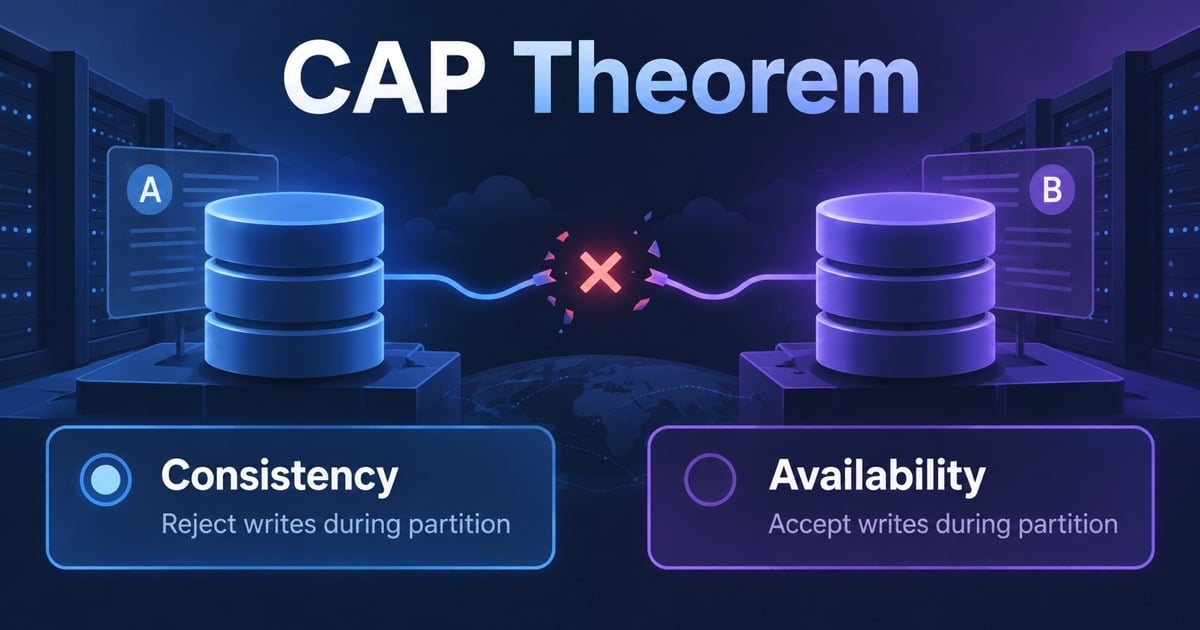
“You can only pick two” is an easy CAP theorem slogan and a poor design answer. A distributed system can provide consistency and availability when the network is healthy. The unavoidable choice appears when a partition prevents replicas from communicating: do you reject uncertain operations or accept them with weaker consistency?
This CAP theorem guide defines the three properties precisely, explains the partition-time trade-off, and connects the theorem to replication and consistency models. Continue from database replication, consistency models, and system-design interviews.
Table of Contents
Open Table of Contents
The Three Properties
- Consistency: a read returns the latest successful write according to the system’s defined linearizable contract.
- Availability: every request to a non-failing node receives a non-error response, even if that response may not include the latest write.
- Partition tolerance: the system continues operating despite messages being delayed or lost between nodes.
flowchart TD
    A[Client write] --> B[Replica A]
    A --> C[Replica B]
    B -. network partition .- C
    B --> D{Partition-time decision}
    D -->|Reject uncertain write| E[CP behavior: preserve consistency]
    D -->|Accept local write| F[AP behavior: preserve availability]
    F --> G[Reconcile after partition]
Partition tolerance is not optional for a system distributed across a network; links fail, packets are delayed, and processes restart. The practical CAP question is therefore what a system does during that partition.
What a Partition Changes
Suppose a user updates an account balance on replica A while replica B cannot communicate with A. If B accepts a conflicting update, two clients may read different values. If B rejects or waits for quorum, it preserves a single answer but some requests fail or block. There is no protocol trick that guarantees both linearizable availability and partition tolerance in this scenario.
The choice is per operation and per data type. A social “like” counter may accept local increments and reconcile later; a payment authorization may reject until a quorum is available. A single product can use CP behavior for inventory and AP behavior for recommendations.
CP and AP Behaviors
| Partition-time choice | User-visible behavior | Suitable examples |
|---|---|---|
| CP | Some reads/writes fail or wait without quorum | Leader metadata, inventory reservation, uniqueness |
| AP | Requests succeed with possible stale/conflicting state | Feeds, telemetry, counters, shopping preferences |
CP and AP are shorthand, not permanent database labels. A CP store may expose stale reads from a follower if the API chooses that consistency level. An AP system may offer strongly consistent reads for a subset of keys. Name the guarantee at the API operation level.
Why the Myth Persists
The “pick two” phrase incorrectly treats C, A, and P as independent checkboxes. In normal operation, a system can be consistent and available while also designed to tolerate future partitions. The impossibility applies to the combination of consistency, availability, and partition tolerance during an active partition under the chosen model.
CAP also does not replace latency, durability, isolation, or cost analysis. PACELC adds the useful question of what the system trades when there is no partition: latency or consistency. Consistency models gives the vocabulary needed to specify those choices.
Applying CAP in a Design
In an interview, state the failure and the user promise first. “If the inventory quorum is unavailable, checkout returns 409 rather than overselling” is a CP decision. “If the recommendations replica is stale, return the previous list and refresh later” is an AP decision. Then explain quorum size, failover, reconciliation, and what operators observe.
Ask whether a network partition is between zones, regions, or a client and service. A cross-region system may choose local reads during a WAN partition and reconcile later, while a single-region leader-follower database may reject writes when it loses quorum. The topology shapes the cost of the choice.
Interview Questions
1. What does CAP theorem actually state?
During a network partition, a distributed system cannot guarantee both linearizable consistency and availability for every request while tolerating the partition. Designers choose whether to reject or delay uncertain operations, or accept them with weaker consistency. It is not a rule that systems permanently pick any two letters.
2. Why is partition tolerance usually required?
Replicas communicate over networks that can fail or delay messages. A system that does not define partition behavior will still encounter partitions, but its behavior will be accidental. Tolerating them means choosing a safe consistency or availability policy and recovering afterward.
3. Is a single-node database subject to CAP?
CAP concerns replicated distributed state and network partitions between replicas or clients and replicas. A single node can be consistent and available until it fails, but it has no replica partition to tolerate. It still has ordinary availability and durability failure modes.
4. Can one system be both CP and AP?
Different operations or data types can make different trade-offs, and systems can change behavior by configuration or failure mode. Calling the whole product CP or AP hides those details. Describe the guarantee for the read or write that matters.
5. How would you explain CAP in an interview?
Draw two replicas separated by a partition, then describe one conflicting operation. State whether the system rejects the operation or accepts it for later reconciliation, and explain why that matches the business risk. Finish with quorum, failover, and observability details.
Conclusion
CAP theorem is a partition-time reasoning tool, not a database shopping label. Networks can partition, so decide which operations preserve consistency by rejecting uncertain work and which preserve availability with reconciliation. State the exact guarantee, failure boundary, and user-visible behavior instead of repeating “pick two.”
References
YouTube Videos
- “CAP theorem in system design interviews” - Hello Interview [https://www.youtube.com/watch?v=Ibf7wKf8MqU]